
A bigger lead list won’t necessarily bring in more tax clients. Effective lead generation for tax preparation businesses starts with reaching the right people, understanding their needs, and following up with a clear purpose.
Timing and trust matter when someone chooses a tax preparer. A practical process helps you respond consistently without overwhelming prospects or losing track of conversations. It also shows which outreach moves potential clients toward a consultation or completed intake.
This guide explains how to define and qualify leads, build useful email and SMS follow-up workflows, and measure campaign performance. You’ll also learn how to use results to refine your approach, whether you’re an independent preparer, an ERO, or building a tax business. A clear system helps focus your outreach and give each promising lead a thoughtful next step.
Key Takeaways
- Define a lead by their interest, contact details, and tax preparation needs so you can tailor your next step.
- Qualify prospects by assessing fit, service needs, timing, and readiness to move forward.
- Build email and SMS follow-ups that share useful information and reach prospects at a thoughtful pace.
- Track campaign results to see which outreach brings in qualified prospects and where your process needs adjustment.
- Connect your growth plans with the right mix of tax software, service-bureau support, and professional training.
Email and SMS outreach workflows
Convert prospects with a focused landing page and relevant email and SMS follow-up. Collect contact details and service needs, then guide each person toward a clear next step.
Personalized Email Sequences
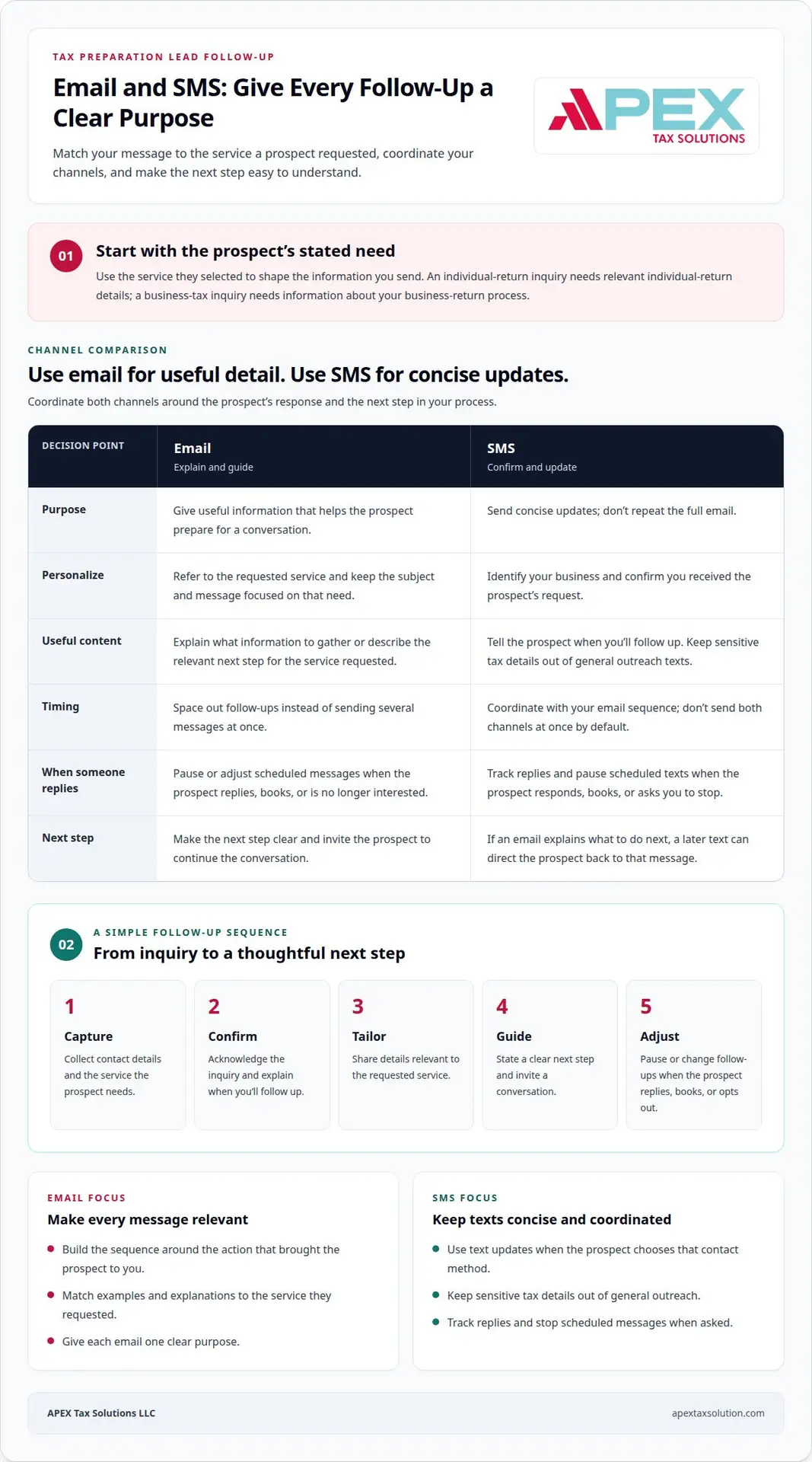
Build each sequence around the action that brought a prospect to you. Someone asking about an individual return needs information tailored to that request; a business owner asking about business taxes needs a different sequence. Confirm the inquiry first, then share useful details to help the prospect prepare for a conversation.
Give each email a purpose. Explain what information to gather before discussing a return, for example, then invite the prospect to continue the conversation. Space out follow-ups rather than sending several messages at once. Pause or adjust the sequence when someone replies, books, or says they’re no longer interested.
Personalized Email Outreach
Personalize beyond the recipient’s first name. Refer to the service they selected, such as individual return preparation, and make the next step clear. Keep the subject line relevant and the message focused on their stated need. This makes your outreach useful rather than generic.
Use the details prospects provide to tailor each message. For example, explain your business-return process to someone who asked about business taxes. Give an individual filer information about how to get started. Match your examples and explanations to the service they requested.
SMS Follow-Up
Use text messages for concise updates, not to repeat every email. When a prospect chooses text updates, identify your business and confirm receipt of their request. Explain when you’ll follow up. Keep sensitive tax details out of general outreach messages.
Coordinate texts with your email sequence. If an email explains the next step, send a later text directing the prospect back to that message. Don’t send both channels at once by default. Track replies, and pause scheduled messages when someone responds, books, or asks you to stop.
Landing Pages and Tax Relief Lists
Connect each landing page to a specific prospect need and one clear action. If you promote tax preparation, describe the service plainly and request useful details, such as a name, preferred contact method, and service requested. After form submission, show a confirmation explaining what happens next.
Keep tax relief email lists separate from general tax preparation contacts, and make each message relevant to the recipient’s stated interest. Describe your services accurately, without implying that preparation includes legal representation. As you plan seasonal reminders, identify April 15 as the approaching U.S. tax-filing deadline, according to the Internal Revenue Service.
What is the best way to generate leads as a CPA?
Build effective lead generation for your tax preparation business around your audience and a clear offer. If you serve independent contractors, create a page for their tax inquiries. Collect each prospect’s name, preferred contact method, location, and service need. Ask whether they want individual or business tax preparation, or accounting support. Use these details to route inquiries and tailor follow-up.
Which lead generation services work best for tax preparers, and how do they compare? Use a landing page to capture interest from people responding to your content or ads. Build relationships through referrals and professional networking, or reach more people through third-party campaigns. Compare audience selection, contact capture, qualification, follow-up, and reporting to identify what fits your business.
Tailor your message to the work each audience needs. For a small-business owner, explain how you handle business tax preparation. For an individual, focus on individual return preparation. State your offer and next step clearly. Don’t suggest your tax preparation services include bookkeeping or legal representation.
Customize each interaction using details prospects choose to share. Offer separate intake choices for individual returns and business tax preparation, for example, then direct each inquiry to relevant information. Add a language preference field if it helps you respond appropriately. If you’re seeking a referral relationship with an accounting firm, write a different message from one aimed at an individual seeking tax preparation.
What lead generation strategies work best for seasonal tax preparation businesses in different local markets? Match outreach to your audience and service area. If you serve local small businesses, participate in business networks. If you specialize in an industry, use LinkedIn search filters to find prospects by industry or geography. Contact relevant prospects with InMail that explains your expertise and how you can help.
Set your campaign scope before launch. Define your audience, geographic area, promoted service, intake questions, and process for handling inquiries. Record each lead’s source, requested service, and progress toward consultation or intake. Use these records to distinguish suitable prospects from contacts who don’t match your practice.
Improve lead generation for your tax preparation business by reviewing campaign records and refining your targeting. If a campaign attracts inquiries for services you don’t provide, revise its message or intake choices. If suitable prospects don’t proceed, clarify the next step in your offer. Use campaign outcomes to guide your next test.
Defining leads for tax preparation businesses
For your practice, define a lead as a person or business that has learned about your services or expressed interest and could become a client. A business owner asking about return preparation is a lead. A website visitor who takes no action hasn’t yet given you contact details to follow up with.
Classify each inquiry by source, service interest, location, and contact details. Note whether the prospect came through a referral, search result, landing page, or online campaign. Record the requested service, such as individual or business tax preparation. These details help you choose a relevant next step and see which sources bring suitable inquiries.
Ask how an online lead campaign handles exclusivity. Some campaigns send a purchased tax lead to multiple preparers, while an exclusive lead goes to one. Review the campaign terms and track whether each prospect responds. Judge lead quality by fit and intent, not just how quickly an inquiry arrives.
Use a prospect’s stated tax-debt amount to understand their concern, not to assume your preparation service is a fit. Distinguish ordinary return-preparation inquiries from tax relief internet leads. Describe your services accurately, and don’t imply that tax preparation includes legal representation. Route each inquiry according to the service requested.
Federal and state requirements for marketing, referrals, and client data depend on your communication methods, information handling, and jurisdiction. Consider applicable privacy and messaging requirements, including the TCPA and CCPA, when planning outreach.
The cost of tax preparation leads depends on the source, targeting, exclusivity, and how closely prospects match your services. Compare contact accuracy and expressed intent alongside cost. This helps you assess whether a campaign brings useful opportunities instead of treating every contact as equally valuable.
To attract local prospects, align your website content with the services and locations you serve, and keep your Google Business Profile accurate. Describe individual return preparation clearly on the relevant page, for example, and make it easy to inquire. This helps nearby people find information that matches their needs.
Follow up according to each prospect’s stated interest. If someone asks about a business return, respond with relevant information and explain how to continue. Record the source and outcome to see which tax preparation leads connect with your practice. Use those patterns to strengthen lead generation for tax preparation businesses.
Lead qualification
Qualification helps you prioritize prospects whose needs match your services. Review each inquiry for requested service, location, timing, contact preferences, and readiness to proceed. Someone requesting an individual return differs from a business owner asking about a business return. Record these distinctions so your team can choose a relevant next step.
Use a consistent process rather than relying on instinct. First, confirm the prospect’s stated need. Next, check whether your business handles that service and location. Then note engagement signals, such as a completed intake form or a reply to follow-up. A qualified lead fits your target audience and has shown interest through a clear action.
Review existing tax leads, too. Check whether the contact information works, the person still wants help, and the requested service remains relevant. A previous inquiry about return preparation may need a fresh conversation before you treat it as an active opportunity. Keep the source and outcome recorded with the lead.
AI-supported tools can help organize engagement by sorting inquiries into categories, flagging duplicate records, or summarizing a prospect’s stated service need. Use the results as prompts for review, not as a final decision. Have a person confirm that an AI-generated summary reflects the original inquiry, especially before sending a tailored response.
- Fit: The requested service matches what your practice handles.
- Intent: The prospect has taken a clear action or replied.
- Contact quality: The details support an appropriate follow-up.
- Next step: The prospect understands how to continue.
How can tax preparers avoid lead-generation scams, low-quality leads, and privacy risks? Review campaign terms, lead sources, consent records, and duplicate handling before using a list. Collect only the information needed for follow-up, restrict access, and align outreach with applicable requirements such as the TCPA and CCPA.
A lead quality guarantee describes what a seller will do when a lead fails agreed criteria. Read the terms for definitions such as invalid contact details, duplicates, or service-area mismatch, and note any claim process. These terms address lead delivery, not whether a prospect will become a client.
Use qualification results to improve your target and engagement. If inquiries repeatedly request services you don’t handle, adjust the campaign message or intake choices. If suitable prospects stop responding after an initial conversation, review the clarity of your next step and the timing of your follow-up.
Lead generation KPIs and campaign setup
Campaign performance requires more than counting leads. Track whether outreach reaches suitable prospects, earns responses, and moves inquiries toward completed intake. During tax season, these measures show which activities contribute to qualified opportunities and where your process loses momentum.
Start by defining each campaign’s audience, offer, and desired action. A campaign for individual return preparation, for example, should use a matching landing page and intake choice. Prepare creative assets and tracking before launch. Having these pieces ready can help you launch a third-party tax-preparation lead-generation campaign efficiently.
Choose KPIs that connect activity to outcomes:
- Lead volume: Count inquiries by source, campaign, and requested service.
- Contact rate: Track which prospects respond to your outreach.
- Qualification rate: Compare suitable inquiries with total leads.
- Intake progress: Record which prospects move from inquiry to completed intake.
- Source performance: Identify which channels bring prospects that fit your services.
Keep definitions consistent across campaigns. Count a lead as qualified only when the requested service matches your practice and the prospect has provided usable contact details, for example. Separate duplicate inquiries from new prospects and record the campaign source. This makes comparisons more useful than a spreadsheet that combines every inquiry.
Review results often enough to take action. If a campaign partner supplies leads, share campaign outcome data daily if possible, so the partner can use it for optimization. Include meaningful outcomes, such as invalid contact details, service mismatch, response, or completed intake. A lead count alone won’t show which adjustments could improve quality.
Seasonality also affects how you interpret results. Advertising performance for U.S. tax-preparation products and services can vary throughout the year. Conversion timing may also vary by campaign and audience. Compare campaign performance within the relevant period rather than treating every week alike.
Use a simple review cycle: confirm tracking, compare lead quality by source, then adjust the audience or message. This makes lead generation for tax preparation businesses easier to evaluate and gives every campaign a clear next improvement.
Apex Tax Solutions
Apex Tax Solutions LLC supports tax professionals with tax software, service-bureau support, and training. If your outreach brings in new prospects, the right operational tools can help you serve them consistently. This can be useful as you add services, expand your client base, or strengthen your office processes.
Lead generation creates opportunities, but your ability to serve each client shapes what comes next. A preparer expanding into business returns, for example, needs software suited to that work and training to use it confidently. Apex Tax Solutions LLC offers TaxSlayer ProWeb and corporate software for tax professionals with different practice needs.
If you’re building or scaling a tax business, consider the Service Bureau Partner Program. The program provides support and resources to help tax offices develop their operations. It may suit a business looking to grow with structured support rather than manage every business-development need alone.
Apex Tax Solutions LLC brings software, support, and training together. This end-to-end approach gives you a place to turn for practical guidance as your business develops. Personalized support can help you address questions without relying on call-center scripts, while continued training helps you build skills and strengthen your client experience.
- Software: Explore TaxSlayer basado en Web or Corp Software based on the services your practice provides.
- Service-bureau support: Consider the Service Bureau Partner Program as you plan to grow your tax business.
- Training: Use Wisp & Cybersecurity Training to build knowledge around cybersecurity practices.
- Personalized help: Get practical support that recognizes the needs of your tax office.
An independent preparer building a client base may value training and a dependable workflow. An established office adding business returns may prioritize software suited to its services. Apex Tax Solutions LLC can help you align software, support, and learning with your business priorities, so you can focus on serving clients and building lasting relationships.
With software, service-bureau support, and training under one roof, Apex Tax Solutions LLC can support your next stage of growth. The right combination depends on your practice, the services you provide, and the areas where you want more guidance.
If you’re ready to discuss support for your tax business, Contact Apex Tax Solutions LLC.
Frequently Asked Questions
How should I go about tax preparation marketing?
Build a consistent plan around the services you want to grow and the clients you can serve well. Keep your business name, service descriptions, and contact details consistent across your website, social profiles, and printed materials. If you want more small-business clients, for example, create educational content that addresses common tax-preparation questions for business owners. Review inquiries by source to learn which messages attract the right audience.
Who is this service for?
Lead-generation support is relevant to independent tax preparers, electronic return originators (EROs), aspiring preparers, and small-business owners building a tax practice. If you need help organizing marketing and client communications, GHL for Tax Offices from Apex Tax Solutions LLC offers marketing automation and communication tools to help you manage prospect interactions as your outreach develops.
What are the most effective lead generation strategies for tax preparation businesses?
Combine clear service information with ways for prospects to discover and evaluate your practice. Publish useful answers to tax-preparation questions, make service pages easy to navigate, and invite satisfied clients to share feedback through appropriate channels. A page explaining your process for new clients, for example, can reduce uncertainty before someone inquires. Review inquiries and new-client sources regularly, then refine the content that brings suitable prospects.
How can tax preparation businesses use paid search and social media ads to attract clients?
Use paid search to reach people looking for a specific tax service, and social ads to introduce your practice to a relevant audience. Focus each campaign on one service and send clicks to a page that explains it clearly. An ad for business return preparation, for example, should lead to a page about that work, not a general homepage. Compare inquiry quality across campaigns before shifting your spending.
What referral and partnership strategies bring clients to tax preparation businesses?
Make referrals easy by explaining which clients you serve and what services you provide. Build professional relationships with complementary organizations, small-business networks, and community groups. You might share a practical tax-preparation checklist with a business association or offer an educational presentation for its members. Track which introductions bring relevant inquiries, and thank referral partners promptly with a personal note that respects each prospect’s privacy.
How much do tax preparation leads cost by source and quality?
Costs depend on the source, targeting, exclusivity, and how closely prospects match your services. Compare contact accuracy and expressed intent alongside cost to assess lead quality.