
Did you know that 60% of small businesses permanently close their doors within just six months of a major cyberattack? For a tax professional, a single data breach isn’t just a technical glitch; it’s a direct threat to your reputation and your legal right to practice. You likely already feel the weight of keeping up with evolving IRS regulations while managing your daily workload. It’s exhausting to worry about a surprise audit or a PTIN suspension because your security documentation doesn’t meet the latest standards.
We understand these challenges and are here to help you navigate the mandatory tax office cybersecurity requirements for 2026. By mastering these federal standards, you can protect your clients’ sensitive data and ensure your practice remains compliant. This guide provides a clear checklist of technical requirements, explains how to draft an effective Written Information Security Plan (WISP), and shows you how Apex Tax Solutions LLC simplifies the entire process. You’ll move from feeling overwhelmed by compliance to feeling confident in your firm’s digital defense.
Key Takeaways
- Identify your legal status under the Gramm-Leach-Bliley Act and understand why the IRS now classifies independent tax preparers as financial institutions.
- Move beyond basic consumer-grade tools by properly deploying the “Security Six” technical controls to shield your office network from external threats.
- Master the mandatory tax office cybersecurity requirements by developing a functional Written Information Security Plan (WISP) tailored to your specific practice.
- Protect your firm from the human element of risk with specialized training designed to help your staff spot sophisticated tax season phishing scams.
- Learn how partnering with a trusted expert for Wisp & Cybersecurity Training can streamline your path to total office compliance and long-term success.
The Legal Framework: Why Tax Office Cybersecurity is Mandatory
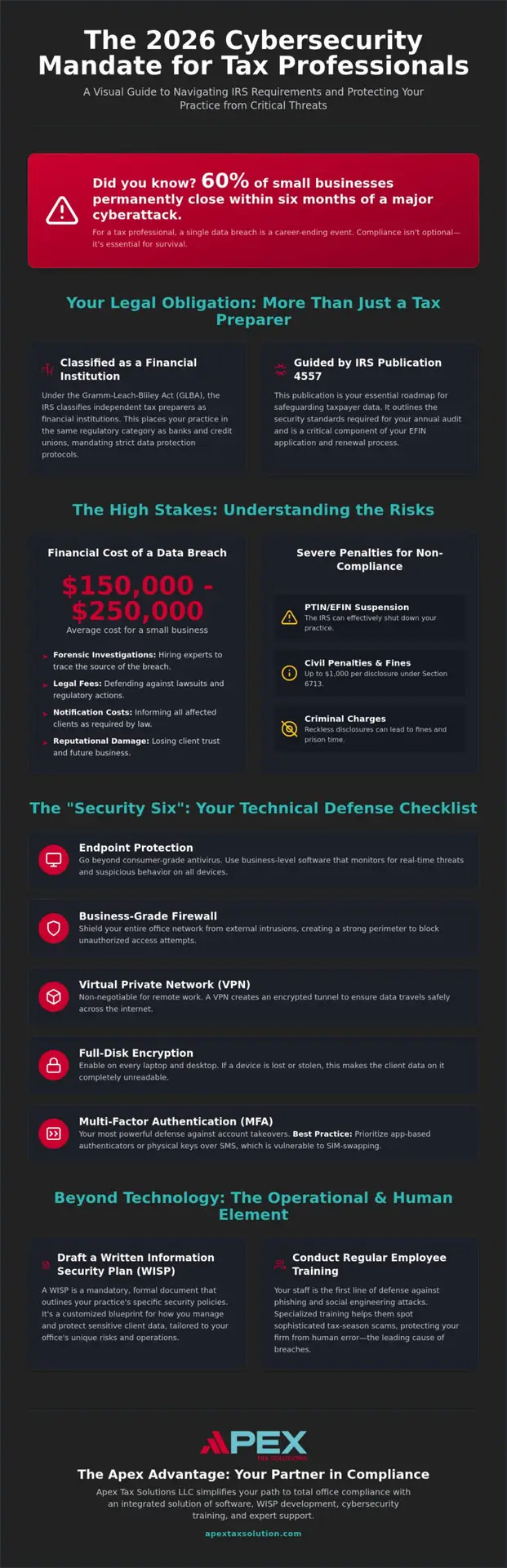
You might think of your business as a neighborhood tax office, but the federal government sees you differently. Under the Gramm-Leach-Bliley Act (GLBA), the IRS classifies independent tax preparers as financial institutions. This designation isn’t just a label. It places you in the same regulatory category as banks and credit unions, making strict tax office cybersecurity requirements a matter of federal law. You’re responsible for the same level of data protection as a multi-state mortgage lender.
The FTC Safeguards Rule enforces these standards, requiring you to protect consumer financial data through a formal security program. These federal cybersecurity regulations ensure that every professional handling sensitive taxpayer information maintains a high level of digital defense. If you fail to comply, the consequences are severe. The IRS can suspend your PTIN or EFIN, effectively shutting down your practice. Beyond losing your license, you face civil penalties under Section 6713 of up to $1,000 per disclosure if identity theft is involved. Reckless disclosures can even lead to criminal charges under Section 7216, carrying fines and potential prison time.
IRS Publication 4557: Your Security Roadmap
IRS Publication 4557 serves as the essential guide for safeguarding taxpayer data. It breaks down protection into seven key areas, including management and educational safeguards. You should use this document as a baseline for your annual security audit to ensure no gaps exist in your defenses. Compliance with these standards is also a critical part of your EFIN application process. The IRS expects you to verify that you’ve implemented these protections before you can electronically file returns for your clients. Mastering these tax office cybersecurity requirements ensures your practice remains a trusted pillar in your community.
The Consequences of Data Breaches
A data breach is more than an IT problem; it’s a financial catastrophe that can end your career. For small businesses, the average cost of a breach often falls between $150,000 and $250,000. These expenses quickly add up through several channels:
- Forensic Investigations: Hiring experts to find the source of the leak.
- Legal Fees: Defending your firm against potential lawsuits or regulatory fines.
- Notification Costs: Complying with the FTC rule to notify affected individuals within 30 days.
- Reputational Damage: Losing the trust of clients who may never return.
When a tax office is compromised, it fuels fraudulent refund claims that can haunt your clients for years. Protecting your data isn’t just about avoiding fines; it’s about honoring the trust your community places in you every tax season.
Implementing the “Security Six” Technical Controls
Meeting modern tax office cybersecurity requirements starts with the “Security Six,” a set of technical safeguards mandated by the IRS. You can’t rely on basic consumer-grade antivirus software to protect client data. Your business needs endpoint protection that monitors for real-time threats and suspicious behavior across all devices. Pair this with a business-grade firewall to shield your office network from external intrusions. These tools work together to create a perimeter that blocks unauthorized access before it reaches your sensitive files.
Remote work adds another layer of complexity to your security posture. If you or your staff work from home, a Virtual Private Network (VPN) is non-negotiable. It creates an encrypted tunnel for data to travel safely across the internet. Additionally, you must enable full-disk encryption on every laptop and desktop. This ensures that if a device is lost or stolen, the data remains unreadable to unauthorized users. These standards are outlined clearly in IRS Publication 4557, which serves as the technical foundation for every compliant tax practice.
Multi-Factor Authentication (MFA) Best Practices
Multi-factor authentication is your most powerful tool against account takeovers. While many people use SMS-based codes, these are vulnerable to SIM-swapping attacks. You should transition to app-based authenticators or physical security keys for higher protection. Your professional tax software must have MFA enabled for every login attempt. This extra step prevents unauthorized users from accessing your client list even if they manage to steal your password. For multi-office teams, a centralized MFA management system ensures that every preparer stays secure without disrupting their workflow.
Encryption and Secure Backups
Protecting data means securing it both at rest on your hard drive and in transit when you send it to the IRS. You should follow the 3-2-1 backup rule. This means keeping three copies of your data on two different media types, with one copy stored offsite. This strategy is your best defense against ransomware attacks that could otherwise freeze your business operations. For established offices that prefer local data control, APEX Corporate Desktop Premium provides a robust Windows-installed suite. It allows you to manage full business entity returns while maintaining strict local security protocols over your database.
Developing Your Written Information Security Plan (WISP)
A Written Information Security Plan (WISP) is the heartbeat of your firm’s compliance strategy. It’s a living document that outlines exactly how your business protects sensitive taxpayer information. Federal law requires every professional tax preparer to maintain one. It’s more than a simple template you download and forget; it’s a functional roadmap tailored to your specific office operations.
The FTC Safeguards Rule requires you to designate a Security Program Coordinator. This person oversees your data protection efforts and ensures your practice stays on track. In a smaller firm, this is usually the business owner. Their job is to verify that all tax office cybersecurity requirements are met and that your staff follows the protocols you’ve set in place.
You must conduct a thorough risk assessment to identify where your client data is most vulnerable. Do you store physical files in unlocked cabinets? Is your local network properly shielded? Once you identify these gaps, you need a documented incident response plan. This plan tells you exactly how to react if a breach occurs, including how to notify the IRS and your clients without delay.
Essential Components of a Compliant WISP
Your WISP must address employee management and training. Every team member needs to know how to handle data securely. You also need clear protocols for your information systems, including regular testing schedules to find new vulnerabilities. Don’t overlook service provider oversight. You’re responsible for ensuring that your software vendors and IT partners maintain security standards that match your own.
Reviewing and Updating Your Plan Annually
Cyber threats evolve constantly, and your security plan must keep up. You should review and update your WISP at least once a year or whenever you make significant changes to your office hardware. Documenting shifts in your software ecosystem is a critical part of this process. If you add new remote preparers or upgrade your local servers, your plan needs to reflect those updates immediately.
Staying compliant doesn’t have to be a solo effort. Our specialized training on Creating a Written Information Security Plan (WISP) helps you build a robust document that meets all IRS standards. We provide the tools and knowledge you need to turn this complex requirement into a source of confidence for your practice.
Employee Training and the Human Element of Security
Technology alone isn’t enough to protect your firm from modern threats. Your employees are your most valuable asset; however, they can also be your biggest vulnerability if they aren’t properly prepared. Meeting tax office cybersecurity requirements means transforming your team into a group of vigilant data guardians. You must move beyond a one-time orientation and develop a continuous culture of security within your office.
Managing access controls is a critical part of this process. You should implement the principle of least privilege, especially for seasonal staff. This means giving team members only the specific access they need to perform their daily tasks. By limiting permissions, you reduce the potential damage if an account is ever compromised. Since many successful firms serve diverse communities, providing bilingual security training is essential. Ensuring that everyone understands compliance protocols in both English and Spanish guarantees that no detail is lost in translation.
Recognizing Modern Phishing Attempts
Cybercriminals often use “spear phishing” to target tax preparers with highly personalized scams. These emails may look like official correspondence from the IRS or a trusted software vendor. They often create a sense of urgency to trick you into clicking a malicious link or downloading a dangerous attachment. You should conduct regular drills to test your team’s awareness and response. If an employee accidentally clicks a suspicious link, they need to know exactly how to report it immediately without fear of reprimand. Quick action can often stop a threat before it spreads through your entire network.
Secure Client Communication Protocols
Sending sensitive documents via unencrypted email is one of the most dangerous habits in a tax office. You must train your staff and your clients to use secure client portals for all document exchanges. These portals ensure that data is encrypted while in transit and at rest. It’s also your responsibility to educate your clients on your communication standards. Let them know that your office will never ask for their Social Security number or bank details via a standard text message or unencrypted email. Clear boundaries protect both your business and the people you serve.
Protect your firm and stay compliant by enrolling your team in our professional Cyber Security Training today.
The Apex Tax Solutions LLC Advantage: Integrating Security and Scaling Your Practice
Many preparers view compliance as a burden that slows down their daily operations. You can choose a different path by turning your commitment to safety into a powerful growth engine. When you meet mandatory tax office cybersecurity requirements, you aren’t just checking a box for the IRS. You’re building a brand that clients can trust with their most sensitive financial information. This trust is the foundation for a scalable, professional practice that retains revenue year after year.
Partnering with a service bureau that understands your specific hurdles makes all the difference for your long-term success. Apex Tax Solutions LLC provides an end-to-end service model that puts software, support, and training under one roof. You don’t have to deal with cold call-center scripts or generic IT advice from vendors who don’t understand the tax industry. Instead, you get personalized mentorship from a Latino-owned, Dallas-based team that has been helping tax professionals succeed since 2015. We offer bilingual support in English and Spanish to ensure your entire team stays informed and empowered.
Software Built for Compliance
Your choice of tools determines how easily you can maintain your tax office cybersecurity requirements during the high-pressure tax season. APEX Cloud Pro offers a 100% cloud-based, 1040-only solution that is perfect for remote or multi-office teams. It features a flat $999 season price with no per-return fees, allowing you to manage costs while staying secure. This setup removes the stress of local server maintenance while ensuring your data is protected by enterprise-grade cloud security. For a deeper look at our cloud offerings, explore our APEX Cloud Pro: The Ultimate 2026 Guide.
If your office handles complex business entity returns like 1120s or 1065s, you need the power of APEX Corporate Desktop Premium. This Windows-installed suite provides local data control and offline capabilities for established offices requiring a robust desktop environment. It ensures that your most sensitive entity data stays exactly where you want it while providing the features required for corporate filing. Both options are designed to keep you compliant without sacrificing the speed your business demands.
Expert Training and Support
Compliance is a moving target, but you don’t have to hit it alone. Our specialized Wisp & Cybersecurity Training provides a clear path to total office compliance. This training keeps you ahead of IRS audits by helping you document your security protocols correctly and efficiently. You’ll gain the confidence to handle data with professional precision, knowing you have a partner that prioritizes your business security as much as you do. Partner with Apex Tax Solutions LLC today to secure your practice and scale your revenue.
Secure Your Practice for the Future
Adopting the full spectrum of tax office cybersecurity requirements is more than a legal obligation; it’s a strategic move for your firm’s longevity. Throughout this guide, we’ve explored how technical controls, written plans, and employee vigilance create a comprehensive shield for your practice. By moving beyond basic compliance, you establish a foundation of trust that separates you from the competition. You’ve seen that the right infrastructure doesn’t just prevent breaches; it empowers your business to scale with confidence.
You don’t have to manage these evolving federal mandates on your own. As an IRS-authorized e-file provider, Apex Tax Solutions LLC offers the specialized Wisp & Cybersecurity Training and software tools needed to keep your office secure. We provide dedicated bilingual support and professional mentorship to ensure you remain compliant and successful in 2026 and beyond. Our team is committed to your growth and the safety of the communities you serve. Secure your practice and discover the Apex advantage today. We’re ready to be the partner that helps your business thrive.
Frequently Asked Questions
Is a WISP required for a single-person tax office?
Yes, a Written Information Security Plan is mandatory even if you are a solo practitioner. The IRS and FTC do not grant exemptions based on the number of employees in your firm. If you handle taxpayer data, you must have a documented plan to protect it. Failing to maintain this document can lead to PTIN suspension. APEX provides specialized Wisp & Cybersecurity Training to help you build a compliant plan quickly.
What are the IRS Security Six requirements for 2026?
The IRS Security Six includes antivirus software, firewalls, multi-factor authentication (MFA), encrypted data backups, full-disk encryption, and virtual private networks (VPNs). These are the minimum technical controls required to safeguard taxpayer information. Implementing these tools is a core part of meeting modern tax office cybersecurity requirements. You should ensure every device in your office has these protections active to remain compliant with IRS Publication 4557 standards.
How often do I need to update my tax office cybersecurity plan?
You must review and update your cybersecurity plan at least once a year. However, you should also update it whenever your business undergoes a significant change. This includes hiring new staff, moving to a new office, or switching your primary tax software. Regular updates ensure your security protocols remain effective against evolving cyber threats. Keeping your documentation current is vital for passing an IRS audit and protecting your professional reputation.
Does professional tax software automatically make me compliant?
No, using professional software is only one piece of the compliance puzzle. While high-quality tools provide built-in security features like MFA, you are still responsible for securing your local network and physical office. Compliance requires a holistic approach that includes employee training and a formal WISP. APEX Cloud Pro simplifies many remote security tasks, but you must still implement the administrative and technical safeguards required by federal law.
What happens if I don’t have a Written Information Security Plan?
Operating without a WISP puts your practice at extreme risk. The IRS can suspend your EFIN or PTIN, which prevents you from filing returns and generating revenue. You also face significant civil and criminal penalties under Internal Revenue Code Sections 6713 and 7216. In the event of a breach, the lack of a documented plan can be used as evidence of negligence, leading to costly legal battles and permanent damage to client trust.
Can I use a free VPN for my tax office remote work?
You should never use a free VPN for professional tax work. Free services often lack the robust encryption needed to protect sensitive taxpayer data and may even sell your browsing history to third parties. Business-grade VPNs provide dedicated support and advanced security features that meet federal standards. Investing in a reliable, paid VPN ensures that your remote connections remain private and that your practice stays compliant with mandatory data protection rules.
How do I report a data breach to the IRS?
If you suspect a data breach, you must contact your local IRS Stakeholder Liaison immediately. They will guide you through the reporting process and help protect your clients from fraudulent filings. You should also notify the FTC if the breach affects more than 500 individuals. Quick reporting is a requirement under the FTC Safeguards Rule and helps mitigate the long-term impact on your business and your clients’ identities.
What is the difference between a WISP and a general data security plan?
A WISP is a specialized document that meets the specific legal requirements of the Gramm-Leach-Bliley Act and the FTC Safeguards Rule. While a general security plan might cover basic IT needs, a WISP must include designated coordinators, risk assessments, and service provider oversight. It is specifically designed to address the unique vulnerabilities of a tax office. Having a compliant WISP ensures you meet the exact tax office cybersecurity requirements expected by the IRS.