
What if your next stage of growth brought more support without putting your client relationships out of your hands? Tax business development through partnership programs can help you build capacity, but you should look beyond broad marketing promises. Understand what you’ll contribute, what support you’ll receive, and how the arrangement fits your business before you commit.
APEX Tax Solutions brings tax software, service-bureau support, training, and mentorship together to support your work as a tax professional. You can get practical guidance and personalized service as you evaluate the tools and support your business needs, while keeping your goals and client relationships at the center of the decision.
This guide explains common partnership models and how to compare their services, responsibilities, costs, and fit. You’ll learn how to assess whether a partnership complements your operations, where it could support growth, and what to review before you commit. Use the framework to identify support that fits your business and your plans.
Key Takeaways
- Explore how tax business development through partnership programs can add tools, expertise, or operational support to your business.
- Compare software, service-bureau, referral, and mentorship models by the support they provide and the responsibilities they place on you.
- Protect your independence by reviewing written terms for client relationships, data access, responsibilities, and exit provisions.
- Use a practical evaluation framework to match a partnership’s software, training, communication, and support to your business goals.
- See how APEX connects software, service-bureau support, training, and mentorship, with options tailored to 1040-only teams or offices handling business-entity returns.
How Partnership Programs Can Support Tax Business Development
Growing a tax office takes more than adding clients. You also need dependable systems, relevant training, and support that can keep pace with your workload. Tax business development through partnership programs gives you a structured way to access these resources while focusing on client service and shaping your business.
A partnership program connects your business with a provider or organization that supplies tools, expertise, or operational support under agreed terms. The arrangement might be a software license or a broader service-bureau relationship. Compare the specific services and responsibilities in the agreement to understand what the partnership will contribute.
What does a tax-business partnership program typically provide?
Depending on the program, support may include tax software, tax preparer training, mentorship, or office-operations guidance. A software license gives you access to tax preparation technology, while a referral relationship focuses on introductions rather than day-to-day operations. A service bureau can combine software with additional business support, making it a broader option than a basic license.
Read the written terms to understand exactly what the program provides and what you remain responsible for. Look for specific descriptions of support, training, communication, and each party’s obligations. Clear expectations help you decide whether the relationship fills a real gap or adds another tool to manage.
Which tax professionals may benefit from a partnership?
If you prepare returns independently, a partnership may give you access to repeatable systems without requiring you to build every function yourself. As an ERO, or Electronic Return Originator, you may also want structured support as your office, team, or workload grows. Focus on whether the program addresses a specific operational need and gives you more capacity to serve clients.
If you’re an aspiring preparer, start with your experience, training needs, and business plans. Identify what you need to learn and the kind of practice you want to build before selecting support. APEX Tax Solutions brings tax software, service-bureau support, training, and year-round mentorship together, giving you connected resources as you develop your business.
Shared infrastructure can reduce the need to assemble every resource separately, but it doesn’t guarantee more clients or revenue. Treat a partnership as support for your business development, not a promise of specific results. Your outcomes depend on your services, decisions, and the terms you accept.
Compare Partnership Models for Tax Business Growth
The right model depends on the support your office needs and the responsibilities you’re ready to take on. Program labels can vary, so compare the actual deliverables, decision-making authority, and agreement terms rather than choosing by name alone.
| Model | Typical support | Your responsibilities | Control considerations | Potential fit |
|---|---|---|---|---|
| Software-only | You get access to tax preparation software. | You manage your office processes and arrange any additional training or support you need. | Review the software, data, and account terms to understand how you’ll manage your work. | This model may suit you if you already have established systems and mainly need software. |
| Service bureau | You receive software alongside service-bureau support, as described in the program terms. | You use the support the program provides and meet the responsibilities in your agreement. | Review how the terms address your client relationships, data access, and responsibilities. | This model may fit if you want connected operational support as your practice develops. |
| Referral partnership | You receive introductions or referrals from a partner. | You manage your part of the relationship and clarify how you and the partner communicate with clients. | Understand who manages each client relationship and what your agreement requires. | This model may suit you if you want introductions rather than office infrastructure. |
| Education or mentorship | You receive training, guidance, or support as you develop skills and business plans. | You apply what you learn and identify any separate operational support your office needs. | Review the program’s scope, format, and any ongoing commitments. | This model may fit if you’re focused on learning and planning, whether your practice is new or established. |
How do service-bureau partnerships differ from software-only options?
A software-only relationship gives you access to a tax preparation tool, but may not include setup, ongoing bureau support, or mentorship. A service-bureau program can provide a broader relationship. Review its written terms to see exactly what support you’ll receive. For a closer look, read What Is a Tax Service Bureau? The Professional Guide to Scaling in 2026.
When are referral, training, or mentorship partnerships a better fit?
A referral relationship may suit you if you want introductions. You and your partner should clarify each party’s role in client communication. Training or mentorship may be a better fit if you want to develop your skills, strengthen office processes, or plan your business over the long term. Each model addresses different needs, and none guarantees a particular growth outcome.
When considering tax business development through partnership programs, focus on what the agreement delivers and what you remain responsible for. If connected software and service-bureau support fit your goals, explore the APEX Service Bureau Partner Program.
Address the Main Concern: Can a Partnership Preserve Your Independence?
A partnership can support your tax office without automatically transferring ownership of your business or client relationships. The agreement defines how the relationship works. Before you commit, understand who communicates with clients, how you access records and data, what each party handles, and how either party can end the relationship.
Support can give you access to software, guidance, or operational resources you’d otherwise need to arrange yourself. The trade-off is reliance: if a partner supports a key part of your workflow, you may have less flexibility to change systems or processes quickly. Tax business development through partnership programs works best when the support strengthens your operations and your role in serving clients remains clear.
Which partnership terms affect control and client relationships?
Read the written terms for details about client communications, records, data access, responsibilities, and ending the relationship. Don’t assume every program handles ownership, access, or termination the same way. Make sure you understand which decisions you make directly and which tasks the partner performs.
You manage your own client relationships and service decisions. If a program provides tax software or operational support, clarify how that support fits into your client communications and office processes. Clear roles help you use the partnership while keeping your approach to client service visible and consistent.
How can you balance support with operational independence?
Separate the functions you want a partner to support from those you want to manage yourself. You might want software and training while retaining control of client communication and day-to-day office decisions. This distinction helps you weigh the practical value of support against the flexibility you want to preserve.
- Define the support: Identify the tools, guidance, or operational help you expect.
- Understand reliance: Consider which parts of your workflow would depend on the partner.
- Review access and exit: Know how you’ll access records and data, and what steps apply if either party ends the relationship.
- Look for clear communication: Favor specific responsibilities and processes over broad promises about growth.
A partner should add support, not confusion. APEX Tax Solutions connects software, service-bureau support, training, and mentorship, with personalized guidance designed to help you build your practice while keeping your business goals in view. Clear expectations help you use that support with confidence and retain control of the decisions that shape your office.
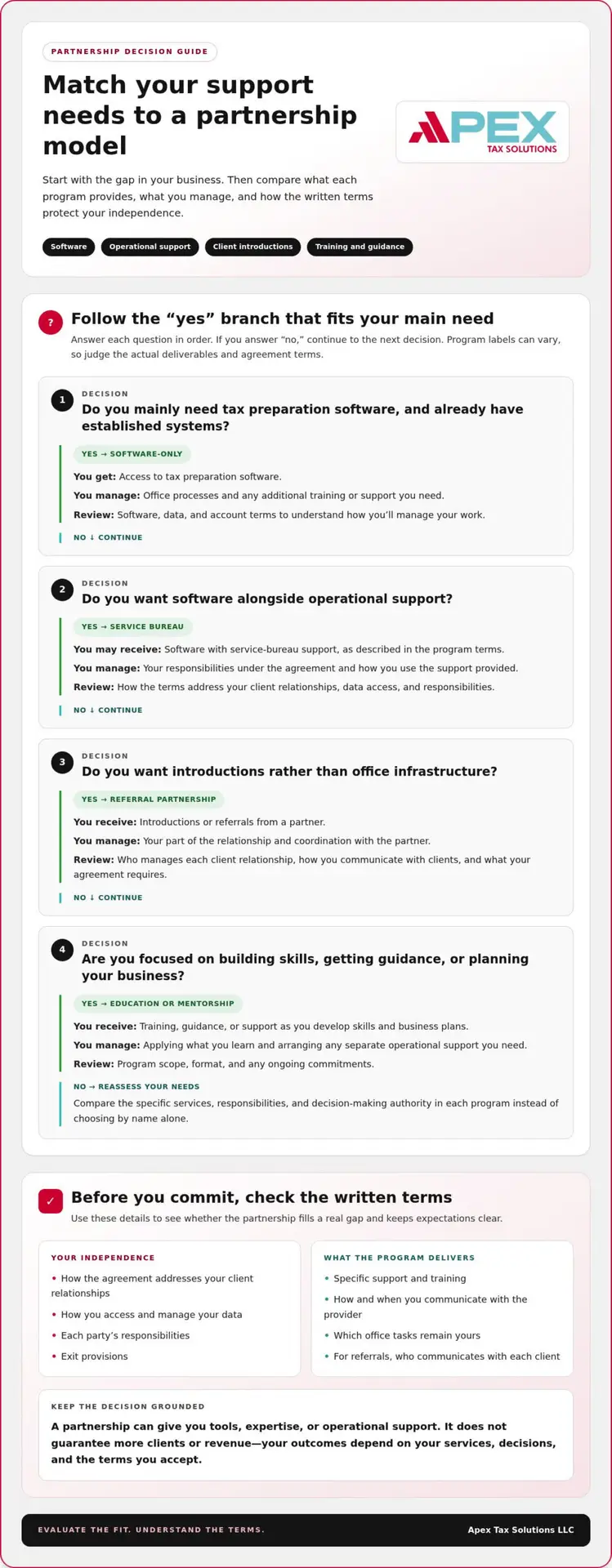
Evaluate a Tax Partnership Program with a Practical Decision Framework
A clear evaluation process helps you choose support that fits your office instead of reshaping your business around a program. Use these steps to connect your goals with practical needs, then assess the relationship against your own business requirements.
- Set your goals and constraints. Identify what you want to improve, such as workflow consistency, staff training, or support as your workload grows. Note current bottlenecks, team capacity, and the time or tools you can commit.
- Map the support to your work. Compare the program’s software, training, mentorship, and operational guidance with your current processes and staff experience. Consider your intended service mix: APEX Cloud Pro is 100% cloud-based and 1040-only for remote or multi-office teams, while APEX Corporate Desktop Premium serves offices that need business-entity returns, offline capabilities, and local data control.
- Check communication and responsibilities. Clarify how you access support, what your team handles, and what the program handles. Look for straightforward communication processes that fit the way your office operates.
- Review the written terms. Understand responsibilities, data access, client-related processes, and how either party can end the relationship. The agreement should describe the actual support you’ll receive, not just broad goals.
- Match the model to your stage. Consider whether the program suits your client volume, team structure, and business plans. If you’re still planning a new practice, How to Start a Tax Preparation Business: A Complete Guide can help you think through your starting point before you compare partnership support.
Next, define how you’ll evaluate the relationship. Choose practical indicators you can observe, such as how responsive support is, whether your workflow feels more consistent, and whether your team completes relevant training. Review client-service capacity and day-to-day operations regularly to spot what’s helping and what still creates friction.
Use your own records and experience to assess progress. A partner doesn’t need to promise a certain number of new clients or a specific revenue increase for you to judge its value. Focus on whether the support meets agreed expectations and helps you run your practice with greater clarity.
APEX connects tax software, service-bureau support, training, and mentorship to help you evaluate support as part of a broader business relationship. Explore the APEX Service Bureau Partner Program as you compare options for tax business development through partnership programs.
How APEX Tax Solutions Connects Software, Support, and Training
Your tax software is only one part of running an office. APEX Tax Solutions brings software, service-bureau support, professional training, and year-round mentorship together, so you can consider the tools and guidance your business needs as one connected model rather than separate pieces.
What does APEX’s end-to-end support model bring together?
APEX’s support model connects tax software and software setup with dedicated bureau support, training, and mentorship throughout the year. You can build your understanding of the tools while getting guidance that supports your work as a tax professional. APEX provides personalized service rather than call-center scripts.
APEX is a Latino-owned business that offers support in English and Spanish. For more detail about learning and assistance, see Professional Tax Software Support and Training Resources.
Which APEX software option fits your office?
Start with the returns you prepare and how your team works. APEX Cloud Pro is a 100% cloud-based, 1040-only solution for remote or multi-office teams. It may suit your office if you focus on individual returns and your team needs cloud-based access.
If your office handles business-entity returns, needs offline capabilities, or prioritizes local data control, consider APEX Corporate Desktop Premium. It’s a Windows-installed suite designed for established offices with those needs. The two options support different workflows, so match the software to your return types and operating preferences rather than assuming one solution fits every office.
Tax business development through partnership programs can bring software, guidance, and learning into one relationship. APEX Tax Solutions has supported tax professionals since 2015, combining these resources to help you build your practice while keeping your business decisions in your hands.
Explore APEX’s partnership support to see how its software, service-bureau resources, and training align with your office goals.
Build Your Next Stage of Growth with the Right Support
Partnerships can give your tax business access to tools, expertise, and guidance, but the right fit depends on what your office needs and what the written terms require of you. Compare the support each model provides, see how it fits your workflow, and review responsibilities, data access, and client-relationship terms before deciding.
Thoughtful tax business development through partnership programs doesn’t require giving up your independence. It means choosing resources that support your goals while keeping your business decisions in your hands. APEX Tax Solutions has supported tax professionals since 2015, bringing software, service-bureau support, and training together. As a Latino-owned business, APEX also offers support in English and Spanish.
Take the next step at your pace. Partner with APEX Tax Solutions today to explore support that fits your office and your plans. With clear priorities and a trusted partner, you can move forward with confidence.
Frequently Asked Questions
What is a partnership program for a tax business?
A tax-business partnership program is a structured relationship that gives your practice access to tools, expertise, or operational support under defined terms. Depending on the model, that may include tax software, training, mentorship, or service-bureau support. APEX Tax Solutions’ Service Bureau Partner Program brings software setup, dedicated bureau support, and year-round mentorship together. Review the program’s scope and responsibilities so you understand what support you can use and what your office manages.
Can a tax preparer partnership program help you grow your business?
A partnership can support your business by giving you access to resources that would otherwise take time to build or coordinate on your own. Tax business development through partnership programs may involve software, training, operational support, or mentorship that helps you strengthen your processes. Results depend on your business, decisions, and how the program fits your needs. Focus on the support and deliverables the agreement describes rather than promises of more clients or revenue.
How do service-bureau programs differ from tax software partnerships?
A tax software partnership generally centers on access to tax preparation software. A service-bureau program can provide a broader relationship, combining software setup, dedicated support, and mentorship. APEX Tax Solutions connects software with service-bureau support and training. Before choosing a model, compare the specific services included and the responsibilities your office retains. Don’t assume a software license includes ongoing guidance or operational support.
What should you compare before joining a tax business partnership?
Compare the program’s support, software fit, training, communication, responsibilities, and written terms. Consider whether it matches your return types, client volume, team structure, and planned services. Review how you access support, what your staff must manage, how the agreement addresses data access, and how the relationship can end. A clear description of deliverables helps you evaluate practical value without relying on broad claims about growth.
Can you keep control of your tax clients when you join a partnership program?
A partnership doesn’t automatically mean giving up your business or client relationships, but the written terms determine how the arrangement works. Review how client communication, records, data access, and each party’s responsibilities are handled. Clarify which service decisions remain yours and how your team will work with the partner. Don’t assume every program uses the same terms. Understanding the details helps you seek support while keeping your client relationships central to your practice.
Is a partnership program a good fit for a new tax preparer?
It may be a good fit if the program addresses your training and business-planning needs, but start by assessing your experience and the type of practice you want to build. Identify the skills you need to develop, the software your work requires, and the guidance you’re looking for. APEX Tax Solutions offers professional tax software, training, and mentorship. Compare those resources with your goals and understand your responsibilities before joining.
How can tax preparers evaluate whether a partnership is working?
Evaluate the partnership against practical indicators you can observe in your office. Track whether support responds as expected, whether workflows feel consistent, whether your team completes relevant training, and whether your office can serve clients effectively. Review these indicators regularly and compare them with the goals you set before joining. Use your own experience and records to assess value rather than relying on promised revenue or client-growth figures.