
Cyberattacks on tax practices spike by 300% during filing season, proving that data protection isn’t an abstract IT chore. Implementing structured cybersecurity training for tax preparers transforms digital defense into an intuitive part of your daily operational workflow. You already know how challenging it is to untangle complex federal standards and train seasonal staff without an in-house IT team, especially when a single compromised file could risk your client trust and your EFIN.
Discover how comprehensive cybersecurity training protects your tax office from costly breaches while fulfilling federal compliance mandates. You will learn practical protocols to satisfy IRS Publication 4557 and FTC Safeguards standards, lock down taxpayer data across every connected device, and build a vigilant team equipped to stop phishing schemes instantly. Here is your complete roadmap to maintaining compliance, safeguarding your clients, and securing your practice for the 2026 tax season and beyond.
Key Takeaways
- Understand your legal obligations under the FTC Safeguards Rule and IRS Publication 4557 to protect your EFIN and taxpayer records.
- Implement structured cybersecurity training for tax preparers that empowers seasonal and permanent staff to recognize advanced phishing threats immediately.
- Establish a dynamic Written Information Security Plan (WISP) that outlines clear procedures for data encryption, device management, and secure file disposal.
- Deploy a practical training timeline featuring baseline awareness checks and simulated phishing exercises before peak tax filing begins.
- Fortify your practice by pairing reliable professional tax software with ongoing compliance mentorship and dedicated bilingual support.
Why Cybersecurity Training Is Mandatory for Every Professional Tax Preparer
Every tax return you prepare contains a complete blueprint of your client’s financial identity. Cybercriminals aggressively target tax offices because client files combine Social Security numbers, dates of birth, wage records, and direct deposit details into a single package. Protecting these sensitive assets requires embedding fundamental information security principles directly into your daily routine. Documented cybersecurity training for tax preparers isn’t an optional professional elective; it is an active federal compliance directive designed to keep your business safe.
Federal Compliance Mandates: IRS Publication 4557 and FTC Safeguards
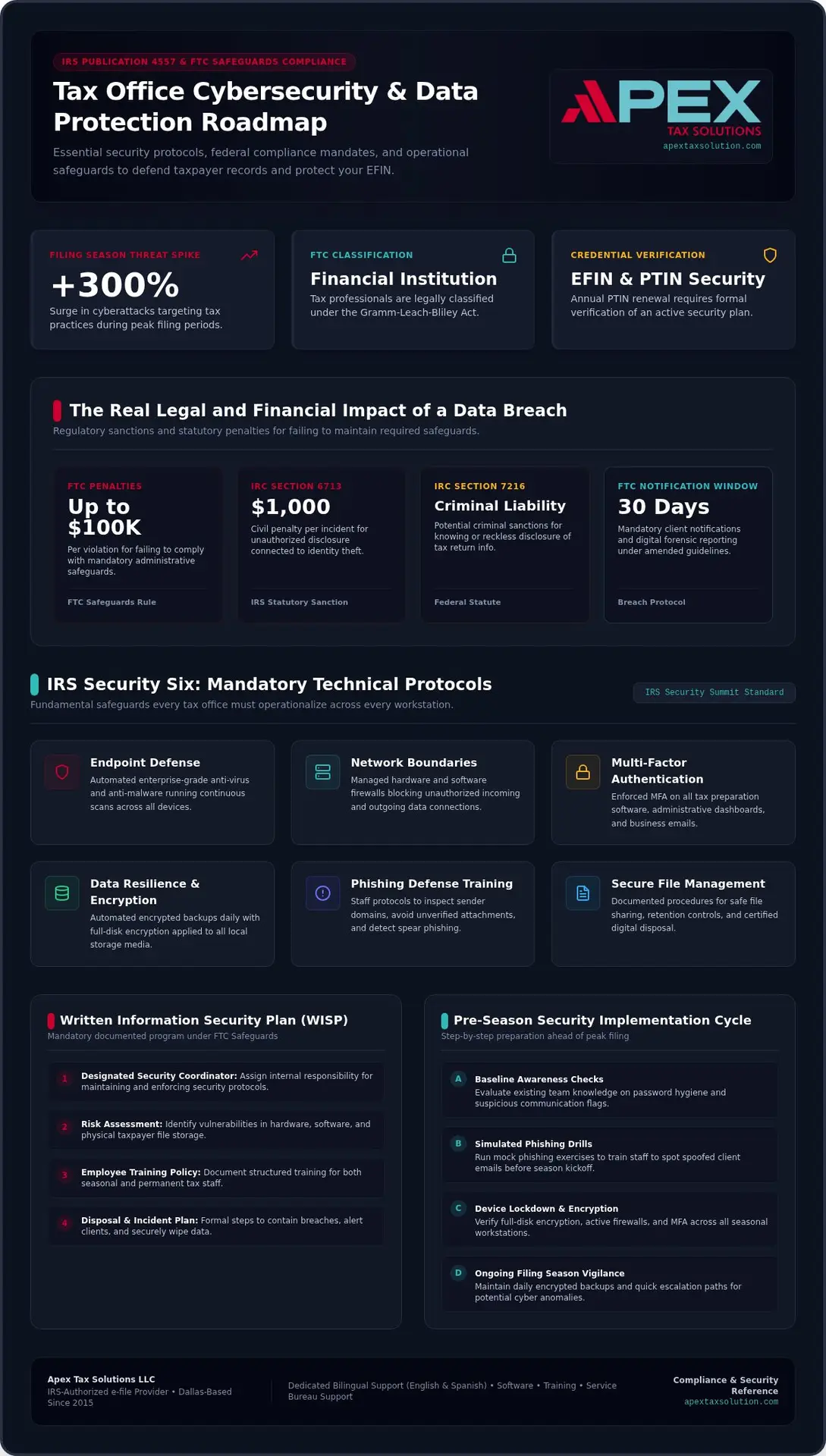
Under the Gramm-Leach-Bliley Act, the Federal Trade Commission legally classifies tax professionals as financial institutions. This status places your practice squarely under the FTC Safeguards Rule, which mandates formal security awareness education for every team member who touches client files. Concurrently, IRS Publication 4557 requires Electronic Return Originators (EROs) to establish documented operational and administrative safeguards.
Federal credential maintenance ties directly to these standards. During your annual Preparer Tax Identification Number (PTIN) renewal, you must formally verify that you maintain an active security plan. Delivering ongoing cybersecurity training for tax preparers proves that your office actively trains seasonal and permanent staff to uphold those standards, keeping your electronic filing status secure.
The Real Financial and Legal Impact of Tax Office Data Breaches
A data breach triggers severe disruptions that go far beyond temporary IT downtime. If attackers compromise your systems, the IRS can immediately deactivate your Electronic Filing Identification Number (EFIN), paralyzing your ability to submit client returns during peak filing periods.
The regulatory and legal liabilities can devastate an unprepared firm:
- FTC Regulatory Penalties: Failure to comply with administrative safeguard standards can trigger federal penalties reaching up to $100,000 per violation.
- IRS Statutory Sanctions: Civil penalties under IRC Section 6713 reach $1,000 per incident for unauthorized disclosures connected to identity theft, alongside potential criminal liabilities under IRC Section 7216 for reckless disclosures.
- Recovery and Reputational Costs: Your practice must cover mandatory digital forensics, state agency alerts, and client notifications within 30 days under amended FTC guidelines, permanently undermining client trust.
Core Pillars of an Effective Tax Office Cybersecurity Curriculum
Security protocols fail when they feel like abstract technical chores. High-impact cybersecurity training for tax preparers bridges that gap by transforming regulatory mandates into instinctive, daily desk habits. By anchoring your seasonal onboarding and ongoing staff education in clear, repeatable actions, your office builds a natural frontline defense that keeps taxpayer files locked down.
Operationalizing the IRS Security Six Protocols
Technical compliance begins with actionable hardware and software management. The IRS Security Summit outlines six fundamental safeguards that every tax office must maintain across every connected workstation. Aligning your internal policies with authoritative FTC cybersecurity guidance ensures your business satisfies baseline federal rules without disrupting tax prep workflows.
- Endpoint Defense: Maintain automated, enterprise-grade anti-virus and anti-malware tools that run daily scans without slowing down file preparation.
- Network Boundaries: Activate managed software and hardware firewalls to block unauthorized incoming and outgoing connections.
- Access Controls: Enforce mandatory multi-factor authentication (MFA) across all tax preparation software, administrative dashboards, and business email accounts.
- Data Resilience: Run automated, encrypted data backups daily, and ensure all local storage drives use full-disk encryption.
Recognizing Phishing, Spear Phishing, and Spoofing Schemes
Cybercriminals frequently disguise malware inside routine tax inquiries. Teach your team to treat unexpected attachments from prospective clients with extreme caution. Train staff to inspect email sender domains before opening PDF forms or clicking cloud-storage download links. Establish a strict verbal verification protocol before changing any client direct deposit routing details or issuing electronic signature requests. Many practices also team up with IT specialists like Trinity Networx, LLC to implement proactive monitoring and advanced threat filtering that stops malicious messages before they hit employee inboxes.
Securing Remote Access and Modern Cloud Data Transfers
Decentralized tax preparation introduces distinct vulnerabilities. Remote team members must use secure Virtual Private Networks (VPNs) and work exclusively on encrypted, firm-managed hardware. Ban the use of open public Wi-Fi networks when accessing client tax returns or administrative portals. Partnering with specialists for guided cybersecurity training helps your firm implement secure remote workflows and protects your professional standing all year long.
Developing and Enforcing Your Written Information Security Plan (WISP)
Federal law requires every tax preparer to create and maintain an active Written Information Security Plan. A WISP is not a static binder meant to sit untouched on an office shelf. It serves as your practice’s operational manual, detailing precisely how your firm safeguards, stores, and securely destroys taxpayer records. Meaningful cybersecurity training for tax preparers bridges the divide between written compliance policies and daily office execution, ensuring your entire staff handles files consistently.
Translating Formal Policies into Everyday Office Workflows
Practical security begins with assigned responsibility and clear desk routines. Designate an internal data security coordinator to supervise daily compliance protocols and manage software access permissions. Grounding your office routines in the official IRS Data Security Guidelines ensures your administrative measures satisfy federal expectations during a compliance review.
Strengthen physical and digital file controls across your workspaces:
- Role-Based Access: Restrict client file access inside your professional tax software so seasonal staff only view returns assigned to their specific preparation queue.
- Clean Desk Standards: Require physical tax folders, intake sheets, and W-2 copies to remain locked inside file cabinets whenever desks are unattended.
- Permanent Media Destruction: Shred physical records using cross-cut shredders and sanitize old computer hard drives permanently before disposing of retired office equipment.
Incident Response Planning and Data Breach Procedures
Preparation dictates how effectively your business survives a digital intrusion. Your WISP must outline immediate containment measures, such as severing infected workstations from the office network and disabling compromised software login credentials. Rapid action isolates threats before malicious code spreads across your primary return database.
Follow a clear external reporting roadmap if unauthorized file access occurs:
- IRS Liaison Notification: Report the security incident immediately to your regional IRS Stakeholder Liaison to flag compromised client identities and protect your electronic filing credentials.
- State Tax Agency Outreach: Contact tax administrators in every state where your impacted clients file returns to prevent fraudulent state refunds.
- Client Communications: Deliver transparent, written breach disclosures that guide clients through protective credit freezes without creating unnecessary panic.
Consistently documenting your cybersecurity training for tax preparers proves your firm actively enforces its WISP, creating the audit trail federal regulators expect. For practices seeking to strengthen broader infrastructure and technical staff readiness, collaborating with IT and security training providers such as Insoft Services can help reinforce vital networking and defense capabilities.
Step-by-Step Guide to Implementing Security Training in Your Office
Timing determines the success of your defense strategy. Rolling out cybersecurity training for tax preparers requires a structured calendar that matches the rhythms of the tax season, especially as you onboard temporary personnel. Tracking completion dates and comprehension scores creates the verifiable paper trail federal auditors expect. For advanced operational strategies that keep administrative workflows running smoothly, review our companion guide on cybersecurity training for tax offices.
Pre-Season Preparation and Staff Onboarding
Evaluate incoming seasonal team members during initial orientation before issuing software credentials. Administer baseline simulated phishing tests in November and December to identify individual vulnerabilities while time permits corrective guidance. Assign unique login profiles to every staff member across your filing software, banning shared office passwords entirely.
Focus pre-season onboarding on practical tax office scenarios:
- Interactive Phishing Drills: Send realistic mock emails simulating fake IRS urgent alerts and software update notifications to test employee caution.
- Intake Protocols: Walk preparers through standard procedures for screening new client documents received via email or flash drives.
- Verification Workflows: Mandate two-step phone confirmations before any preparer alters stored client banking details.
Continuous Learning and Mid-Season Security Refreshers
Security awareness shouldn’t end when filing season opens in January. Cybercrime tactics shift rapidly during peak volume, demanding brief, weekly five-minute standup reviews. Use these huddles to review real-world fraud schemes currently circulating across the tax industry. Ensure critical software patches install promptly without interrupting scheduled client appointments.
Celebrate vigilance within your firm to build an active defense culture. Publicly praise employees who detect suspicious communications or question unusual system behaviors. When your entire team embraces data protection as a collective responsibility, you insulate your business against costly disruptions.
Protecting taxpayer records requires consistent action and the right support system. Partner with Apex Tax Solutions LLC today to implement hands-on compliance training and secure software built for growing tax practices.
Strengthening Your Practice with Dedicated Software, Support, and Training
Succeeding during tax season requires more than standalone security software or isolated webinars. You need dependable professional tax platforms that integrate defense protocols into daily filing routines, supported by an experienced partner who understands the operational demands of tax season. Pairing reliable software with practical compliance education eliminates administrative guesswork and protects your revenue. If you want to expand your practice and build an independent brand, explore what is a tax service bureau to discover the complete infrastructure available to growing firms.
Choosing Secure Professional Platforms for Client Data Protection
Your preparation software serves as the central vault for confidential taxpayer identities. Choosing the right architecture protects your data while matching your office workflow:
- APEX Cloud Pro: Streamlines individual 1040 preparation through a 100% cloud-based environment, allowing remote and multi-office teams to prepare returns securely from any web browser without maintaining local server hardware.
- APEX Corporate Desktop Premium: Delivers full-featured power for complex business returns, including 1120 corporate and 1065 partnership filings, with offline processing capabilities and complete local control over your client database.
Review our comprehensive guide to corporate tax software for preparers to identify the ideal software setup for your firm’s business entity workload.
The Value of Dedicated Mentorship and Bilingual Assistance
Software features alone cannot replace personalized operational support. APEX Tax Solutions backs your team with experienced professionals who understand real tax office workflows, providing responsive guidance without call-center scripts. Our dedicated bilingual support in English and Spanish ensures every member of your team masters critical software functions and compliance steps without confusion.
As an IRS-authorized provider trusted by tax professionals nationwide since 2015, APEX delivers a complete ecosystem that unites reliable tax software with hands-on WISP and cybersecurity training for tax preparers. Discover the APEX advantage and gain a long-term partner committed to keeping your business secure, compliant, and positioned for sustainable growth.
Secure Your Tax Practice and Protect Your Clients for 2026
Establishing rigorous data protection protocols does more than satisfy federal mandates. It preserves the vital trust your community places in your practice every tax season. Comprehensive cybersecurity training for tax preparers equips your seasonal and permanent staff to neutralize deceptive scams, enforce an active WISP daily, and shield your EFIN from costly disruptions.
You don’t have to manage evolving regulatory burdens without support. Trusted by tax professionals nationwide since 2015, APEX Tax Solutions is an IRS-authorized e-file provider offering dedicated compliance and operational mentorship. Our comprehensive ecosystem pairs secure tax software suites with expert WISP training under one roof, backed by responsive, personalized guidance. Partner with APEX Tax Solutions today to fortify your office workflows, keep your client data secure, and lead your business with total confidence.
Frequently Asked Questions
Is cybersecurity training legally required for all professional tax preparers?
Yes, federal law legally mandates security awareness education for all professional tax preparers. Under the Gramm-Leach-Bliley Act and the FTC Safeguards Rule, tax preparers are classified as financial institutions required to train staff on data safety. Additionally, IRS Publication 4557 requires documented technical and administrative safeguards. Conducting ongoing cybersecurity training for tax preparers ensures your office maintains full regulatory compliance and protects your annual PTIN and EFIN credentials.
What is the IRS Security Six and why does my office need it?
The IRS Security Six represents a baseline set of core technical controls designed by the Security Summit to prevent tax-related identity theft. These six standards include anti-virus software, network firewalls, multi-factor authentication, routine data backups, drive encryption, and secure virtual private networks. Implementing these measures guards your workstations against ransomware, unauthorized intrusions, and fraudulent e-filings, giving your office the technical foundation needed to keep client data safe.
How often should tax office staff complete cybersecurity awareness training?
Your staff should complete formal cybersecurity awareness training at least once a year, with targeted refreshers conducted throughout filing season. Onboard seasonal employees with baseline training before granting software access in late autumn. Reinforce this education with brief weekly reviews during peak filing periods to address active phishing schemes. Regular repetition ensures your team stays alert and keeps security protocols top of mind when processing high return volumes.
What happens if a tax preparer experiences a data breach without a WISP?
Operating without a Written Information Security Plan exposes your practice to severe federal enforcement actions if a breach occurs. Regulators like the FTC and IRS view the absence of a WISP as willful non-compliance, resulting in heavy civil penalties and immediate EFIN suspension. You also face expensive mandatory forensic investigations, legal liability from affected taxpayers, and catastrophic reputational harm that can permanently shutter an independent tax office.
Can small or home-based tax preparation businesses skip formal security protocols?
No, federal data security mandates apply equally to every professional preparer regardless of company size or location. Sole practitioners and home-based preparers handle the exact same sensitive taxpayer data as large accounting firms, making them attractive targets for cybercriminals. Implementing a WISP, locking down home office Wi-Fi, and completing regular cybersecurity training for tax preparers protects your independent practice from devastating liability and credential revocation.
How does modern tax software protect client records against digital theft?
Modern tax software integrates multi-layered technical protections directly into your preparation environment. Secure cloud solutions like APEX Cloud Pro provide end-to-end data encryption, automated offsite backups, and enforced multi-factor authentication for browser sessions. For offices managing corporate filings locally, APEX Corporate Desktop Premium safeguards business returns through restricted local database controls. These platforms prevent unauthorized access while keeping your electronic filing workflows completely seamless.
What immediate steps should an office take if an employee clicks a phishing link?
Immediately disconnect the affected workstation from your office network by unplugging its Ethernet cable or disabling Wi-Fi to isolate the threat. Change all tax software, email, and administrative passwords from a clean, separate device right away. Run a deep anti-malware scan on the impacted computer, notify your office security coordinator, and consult your incident response plan to determine if mandatory reporting to the IRS Stakeholder Liaison is required.