
Buying another standalone software tool won’t fix your tax season bottlenecks; it usually multiplies them. When you’re forced to juggle separate programs for intake, document storage, and e-filing, valuable hours disappear into manual data entry. Building a modern tech stack for tax preparers isn’t about collecting more apps. It’s about connecting every part of your office into a unified, reliable workflow.
You already know the frustration of surprise per-return transmission fees and the anxiety that comes with mandatory IRS Written Information Security Plan (WISP) enforcement. You deserve a setup that protects your margins and gives you genuine peace of mind. In this complete 2026 guide, you’ll discover how to build an integrated, secure, and scalable technology architecture for your modern tax practice. We’ll explore the core layers of an efficient firm, from cloud tax engines and automated client portals to rock-solid compliance safeguards.
Key Takeaways
- Discover how building an integrated tech stack for tax preparers eliminates redundant data entry, reduces operational costs, and speeds up your filing turnaround.
- Learn the four essential architectural layers every high-performing office needs to connect client intake, tax calculations, automated communication, and data protection.
- Compare the distinct advantages of browser-based cloud software and high-capacity desktop platforms to select the ideal engine for individual or business returns.
- Understand critical federal compliance standards, including mandatory Written Information Security Plans (WISP) and multi-factor authentication controls that protect your EFIN.
- Explore how an end-to-end service bureau partnership provides predictable pricing, unscripted support, and the professional training necessary to scale your firm.
What Is a Modern Tech Stack for Tax Preparers?
Running a profitable tax practice requires far more than basic calculation tools. A true tech stack for tax preparers operates as an integrated digital operational ecosystem. It connects your client intake, document collection, tax calculation engine, and secure communication channels into one smooth workflow. In computer science, a software tech stack combines specialized software layers to execute complex operational workflows reliably. For your practice, that cohesive architecture directly dictates your daily processing capacity, office turnaround times, and net profit margins.
Legacy tax practices often struggle with fragmented platforms that require constant manual updates. In contrast, modern connected infrastructures automate repetitive administrative work so you can focus on high-value advisory services and return accuracy.
The Evolution of the Digital Tax Office
Professional tax preparation has moved far beyond physical drop-offs, paper folders, and filing cabinets. Relying on standalone spreadsheets and physical records introduces fatal operational liabilities into your business. Paper files invite data breaches, while manual document tracking slows your seasonal turnaround to a crawl.
Modern preparers now use secure, connected cloud capabilities to serve clients nationwide. You can onboard taxpayers digitally, review source documents remotely, and deliver finished returns without geographic limitations.
The High Cost of Disconnected Point Solutions
When your office applications operate in isolated silos, your billable hours quickly slip away. Manually copy-pasting taxpayer information between your billing software, email inbox, and filing program wastes valuable time. This redundant data entry also causes synchronization errors and profile typos that lead to IRS e-file rejections.
Switching between five or six separate vendor platforms causes severe software fatigue for your team during peak tax deadlines. Investing in a unified tech stack for tax preparers replaces that administrative chaos with a dependable architecture trusted by tax professionals nationwide.
The Four Core Layers of an Efficient Tax Office Infrastructure
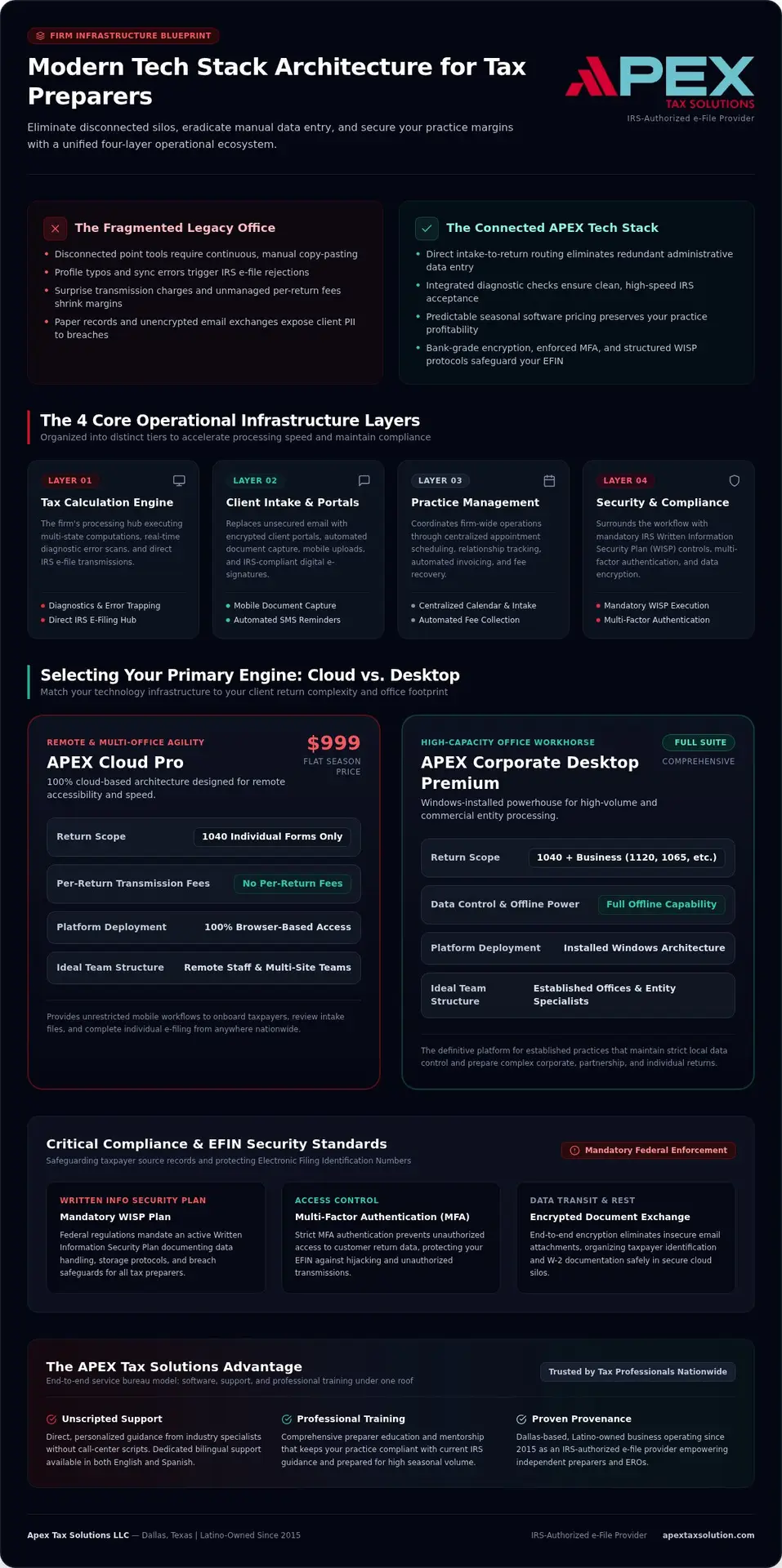
Building a high-performing practice requires organizing your software into distinct, complementary operational tiers. Instead of relying on random tools, an optimized tech stack for tax preparers divides daily operations into four functional layers: tax preparation, client intake, practice management, and security. When these components connect directly, data moves cleanly from one stage to the next, reducing processing time per return.
Layer 1: The Core Tax Preparation Engine
Your calculation software serves as the central engine of your firm. It handles multi-state calculations, real-time diagnostic checks, and direct IRS e-filing transmissions. As highlighted in the annual Journal of Accountancy tax software survey, software reliability and e-file stability remain top priorities for filing professionals. Depending on your firm’s focus, you’ll need specialized workflows: agile cloud environments for individual 1040 returns, or robust desktop installations for complex corporate entities like Forms 1120 and 1065.
Layer 2: Client Intake, Portals, and Communication
The second layer manages taxpayer interactions before calculation begins. Sending sensitive tax documents through regular email creates massive security vulnerabilities. A modern portal provides encrypted document uploads, automated file organization, and mobile-friendly document capture. Pair this with automated SMS reminders and IRS-compliant digital e-signatures to eliminate communication bottlenecks and speed up client reviews.
Layers 3 and 4: Practice Management and Compliance Safeguards
Your third layer coordinates day-to-day office workflows. It unifies appointment scheduling, client relationship tracking, and automated invoicing so your staff never chases unpaid fees. The final layer surrounds your entire operation with mandatory security safeguards, including multi-factor authentication, data encryption, and Written Information Security Plan (WISP) controls.
Connecting these operational tiers safeguards your revenue and keeps your staff productive throughout the filing season. If you want to simplify this architecture with software and mentorship designed for growth, you can evaluate modern software packages through Apex Tax Solutions LLC.
Cloud vs. Desktop Tax Software: Selecting Your Primary Engine
Choosing the central calculation engine forms the bedrock of your tech stack for tax preparers. Your decision dictates your hardware setup, seasonal overhead, and daily filing speed. Neither deployment model is universally superior. Instead, the right platform depends entirely on whether your firm prepares high-volume individual returns or handles complex corporate filings with localized database controls.
Both models must also fulfill strict FTC Safeguards Rule requirements. These federal mandates govern encryption standards, multi-factor authentication, and technical administrative safeguards across all tax preparation environments.
- Accessibility: Cloud platforms enable instant browser access from any device, while desktop software operates on dedicated local workstations.
- Form Complexity: Pure cloud tools excel at high-speed 1040 processing, whereas desktop suites provide deep computational power for multi-state corporate entities.
- Data Management: Cloud vendors maintain automated server backups, while desktop platforms provide complete offline access and local data sovereignty.
When Browser-Based Cloud Solutions Excel
Pure cloud tax software frees your practice from local server maintenance, manual patches, and hardware crashes. You can prepare, review, and e-file returns securely from any computer with an internet browser. This mobility makes browser-based tools ideal for remote teams, multi-site practices, and high-volume individual filing services.
APEX Cloud Pro provides the standard 100% cloud-based 1040 solution for firms seeking remote agility. It delivers comprehensive individual filing capabilities under a predictable flat $999 season price with zero per-return transmission fees, protecting your margins as your return volume expands.
When High-Power Desktop Suites Are Necessary
Commercial firms handling corporate entities require deep computational capabilities that standard browser tools cannot match. When preparing complex returns for C-corporations (Form 1120), S-corporations (Form 1120-S), partnerships (Form 1065), and estates (Form 1041), high-speed local processing is essential.
APEX Corporate Desktop Premium provides the robust Windows-installed engine required for full business entity returns. It gives established practices offline data entry, granular multi-state allocation controls, and direct local data ownership to anchor a dependable tech stack for tax preparers.
Integrating Security, Compliance, and CRM Automation
Connecting your client intake to federal security protocols transforms your firm from a disorganized operation into a scalable enterprise. Client relationship management tools should never exist on an island separate from your filing workflow. When you build a modern tech stack for tax preparers, your client communication pipelines must align directly with IRS data security standards.
Adopting robust cybersecurity controls does more than protect your Electronic Filing Identification Number (EFIN). It builds immediate trust with high-value clients who demand complete confidentiality for their financial records. If you want broader executive guidance on aligning cybersecurity, data, and technology with your firm’s growth strategy, check out TechAxis Advisors.
Mandatory IRS Compliance and WISP Implementation
Federal regulations mandate that every professional tax practice maintain a documented Written Information Security Plan (WISP). IRS Publication 4557 outlines explicit safeguards you must enforce, including data encryption at rest and in transit, multi-factor authentication, and strict third-party vendor oversight. Completing targeted cybersecurity training for tax offices ensures your practice implements these technical controls correctly and remains fully audit-ready.
Automating Client Acquisition and Onboarding with GHL
Manual client follow-ups consume hours of administrative time during peak filing deadlines. Integrating specialized GHL for tax preparers automates your lead capture, appointment booking, and document submission reminders. Taxpayers receive instant notifications via SMS and email, which keeps your pipeline full while eliminating seasonal communication bottlenecks.
Mastering Workflow Automation Across the Office
True operational efficiency occurs when intake data flows directly into your preparation queue without manual re-entry. Adopting proven strategies for tax office workflow automation links document ingestion, status tracking, and automated invoicing in real time. Enforcing role-based access controls inside your applications prevents unauthorized team members from accessing sensitive taxpayer information.
Upgrading your digital infrastructure eliminates administrative drag and secures your client records against costly regulatory fines. To deploy a fully integrated, compliant operating system for your firm, partner with APEX Tax Solutions today.
How to Build and Scale Your Stack with APEX Tax Solutions
Assembling separate pieces of software from independent vendors leaves your practice vulnerable to integration breakdowns and rising software fees. APEX Tax Solutions delivers a complete operational ecosystem that combines professional software, direct mentorship, and compliance training under one roof. Instead of dealing with impersonal software corporations, you gain a dedicated partner committed to helping you retain revenue and scale your client base.
As an IRS-authorized e-file provider empowering tax professionals nationwide since 2015, APEX provides direct, unscripted bilingual support in English and Spanish. You get immediate access to experienced tax professionals who understand the practical demands of filing season, eliminating the frustration of scripted call-center runarounds.
The Service Bureau Advantage for Growing Practices
Independent tax offices often pay steep prices for standalone software licenses and transmission add-ons. Partnering with an established tax service bureau gives you top-tier professional software backed by hands-on business coaching and technical onboarding. This structure provides transparent pricing models that protect your operating margins as return volume grows.
You also receive continuous technical troubleshooting and professional guidance throughout the year. Having seasoned industry mentors review your operational strategy ensures your firm remains resilient during peak deadlines.
Comprehensive Support Under One Roof
APEX simplifies your operations by integrating every vital component of your business into a single ecosystem:
- Professional Tax Engines: Choose APEX Cloud Pro for high-speed individual 1040 returns with zero per-return fees, or deploy APEX Corporate Desktop Premium for complex business returns like Forms 1120, 1120-S, and 1065.
- Full Compliance Training: Master federal data security mandates with step-by-step guidance to implement a compliant Written Information Security Plan (WISP).
- Automated Client Management: Deploy specialized CRM workflows that capture taxpayer leads, automate appointment booking, and collect intake documents.
- Dedicated Bilingual Support: Receive real-time technical and tax preparation assistance in both English and Spanish from dedicated industry experts.
Next Steps to Transform Your Tax Practice
Begin by evaluating your current software subscriptions. Identify redundant tools, manual data bottlenecks, and hidden transmission fees that eat into your seasonal profits. Upgrading your firm with an integrated tech stack for tax preparers replaces administrative friction with predictable, scalable growth.
Take the next step in elevating your practice. Discover the APEX advantage and partner with a trusted nationwide service bureau today.
Transform Your Practice with an Integrated Modern Infrastructure
Operating a successful firm in 2026 demands more than just enduring another grueling tax season. Deploying an optimized tech stack for tax preparers liberates your team from administrative chaos, eliminates manual data entry, and protects your seasonal profit margins. When your intake workflows, core tax engines, and mandatory security safeguards communicate seamlessly, your office gains the capacity to serve more taxpayers with less friction.
You don’t have to build that future in isolation. As an authorized IRS e-file provider trusted by tax professionals nationwide since 2015, APEX Tax Solutions backs your practice with complete infrastructure under one roof. You get direct, unscripted bilingual support in English and Spanish alongside transparent software solutions like APEX Cloud Pro at a flat $999 season price with zero per-return transmission fees.
Take control of your workflow, safeguard your revenue, and elevate your practice. Discover the APEX advantage and partner with APEX Tax Solutions today to position your business for lasting growth.
Frequently Asked Questions
What software tools are essential in a modern tech stack for tax preparers?
An essential tech stack for tax preparers requires four core components: a professional calculation engine for filing, a secure client portal for document exchange, automated practice management software for scheduling and billing, and comprehensive cybersecurity controls. Connecting these systems eliminates duplicate data entry and keeps your office organized. Instead of juggling detached apps, an integrated setup lets your staff track return statuses, collect electronic signatures, and communicate with clients seamlessly.
Can I run a professional tax office entirely on cloud-based tax software?
Yes, you can run an agile, highly profitable office entirely in the cloud if your firm focuses on individual Form 1040 returns. Platforms like APEX Cloud Pro allow remote teams to interview taxpayers, input data, and transmit e-files from any internet browser without maintaining local servers. However, if your practice handles multi-state corporations or complex partnerships, adding a dedicated desktop engine ensures you have the computational power needed for specialized entity schedules.
What is a Written Information Security Plan (WISP) and is it legally required?
A Written Information Security Plan is a formal, documented strategy outlining how your practice protects taxpayer nonpublic personal information from theft and digital interception. Under the FTC Safeguards Rule and IRS Publication 4557 guidelines, every authorized e-file provider and paid preparer is legally mandated to maintain an active WISP. Failing to implement one jeopardizes your EFIN and exposes your firm to severe federal penalties and administrative audits.
How does CRM software like GoHighLevel integrate into a tax preparation business?
Specialized CRM software organizes client acquisition and ongoing communication into automated pipelines. When integrated into your practice, platforms like GHL capture prospective taxpayer leads, confirm appointments automatically, and send prompt SMS reminders for missing tax documents. This automation keeps your preparation pipeline moving smoothly during the busiest filing weeks, freeing your team from answering routine status calls and manually following up on unsigned authorization forms.
What is the main difference between individual and corporate tax software solutions?
The primary difference lies in return complexity, calculation depth, and deployment structure. Individual software focuses strictly on Form 1040 workflows, prioritizing cloud mobility, rapid intake, and standard schedules. Corporate solutions, such as APEX Corporate Desktop Premium, are installed locally to manage complex multi-entity structures, including Forms 1120, 1120-S, 1065, and 1041. These desktop engines provide detailed depreciation tables, partner allocations, and offline calculation capabilities that high-volume business returns require.
How does partnering with a tax service bureau improve my practice profitability?
Partnering with a service bureau gives you enterprise-grade software and professional mentorship without the exorbitant licensing fees charged by traditional corporate vendors. You gain access to transparent pricing models that eliminate surprise per-return transmission charges, protecting your profit margins as your practice expands. A dedicated partner also delivers unscripted technical support, compliance training, and year-round business coaching, helping you scale an optimized tech stack for tax preparers with total confidence.