Your brand can stay front and center while a service bureau supports the work behind it. The Service Bureau Partner Program branding customization options you choose can shape co-branded marketing materials, service descriptions, landing pages, and how the partnership works behind the scenes. A well-planned setup connects customer-facing details with your agency’s identity and the support you intend to provide.
A consistent brand helps customers recognize your business. The practical decisions are what to customize, how visible your partner should be, and how to organize the relationship so customers have a clear, connected experience.
This guide covers aligning logos and tone of voice, tailoring service descriptions and online pages, and defining communication and responsibilities. It also explains how a service bureau partnership can support a tax software business and how Apex Tax Solutions LLC fits when you’re ready to explore that model.
Key Takeaways
- Choose which marketing materials carry your agency’s identity and where partner branding appears.
- Align logos, messaging, and tone across customer-facing communications for a more consistent brand experience.
- Shape service packages around your customers’ needs and your agency’s workload.
- Set clear expectations for communication, responsibilities, and whether your partner stays behind the scenes.
- Design landing pages that connect your agency’s brand with a clear, straightforward next step for prospective customers.
Co-branded digital and print marketing materials
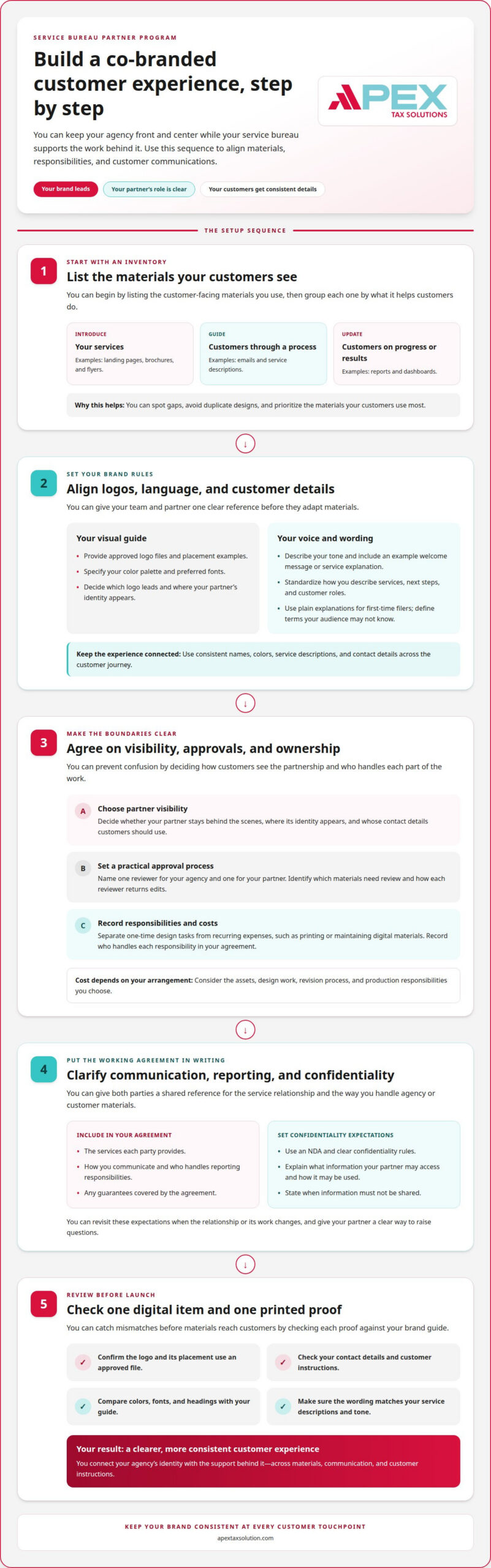
Co-branding connects your agency’s identity with a service bureau’s support. Start by listing the customer-facing materials you use, such as emails, flyers, brochures, and service descriptions.
Customizable Customer-Facing Materials
Plan your branding across digital and print materials, including emails, reports, dashboards, and marketing pieces. For example, a new-client email can feature your agency’s logo and contact details, while a printed flyer explains the services customers can access through your business. For ongoing physical communications like client invoices and notices, partnering with print and mail specialists such as Integrity Statements ensures statements reflect the same professional standards.
Choose materials with the customer journey in mind. A prospective customer might first see a landing page or brochure, then receive an email with next steps. Consistent names, colors, and service descriptions connect these interactions and reinforce your agency’s brand.
Before design begins, make a simple inventory of your materials. Group them into three categories: materials that introduce your services, those that guide customers through a process, and those that provide updates or results. This helps reveal gaps, avoid duplicate designs, and prioritize materials customers use most.
Co-branded materials also need clear boundaries. Decide which logo leads, where the partner’s identity appears, and whose contact details customers should use. Record those choices in a short brand guide with approved logo files, color values, writing style, and examples of acceptable placement.
Branding Change Approvals
Branding limits and approval steps depend on your agreement with the partner. Define who approves a revised logo placement, new service description, or updated email template before either party publishes it.
Build a practical review process into the relationship. Name one reviewer for your agency and one for the partner, then agree which materials need review and how each reviewer returns edits. This separates routine copy changes from major brand updates.
Setup and ongoing costs depend on the assets, design work, revision process, and production responsibilities in your arrangement. Separate one-time design tasks from recurring expenses, such as printing or maintaining digital materials, and record who handles each in the agreement.
A white-label partnership agreement should spell out services, communication, reporting responsibilities, and guarantees. Include confidentiality expectations. A written agreement and NDA can help protect customer information and clarify how both parties handle agency materials.
Before launch, review a digital item and a printed proof against your brand guide. Check the logo, contact details, service wording, and customer instructions. This final review can catch inconsistencies before materials go out and help create a consistent customer experience.
Applying an agency’s logo and tone of voice
Your logo and writing style help customers recognize your agency. Set visual and language rules before adapting partner materials so every customer touchpoint reflects the same identity.
A white-label partner can apply your agency’s logo and style to materials such as reports, dashboards, emails, and strategies. Your colors can guide the visual design. Treat use of your own domain as a separate arrangement detail to define before launch.
Start with a concise brand guide. Include approved logo files, your color palette, preferred fonts, and examples of acceptable logo placement. Add a short description of your tone, such as “clear, calm, and practical,” then show how it sounds in a welcome message or service explanation.
Next, standardize the language your team uses. Choose how you describe services, explain next steps, and address customers. For example, if your agency says “your tax preparation team,” avoid switching to “our partner’s team” in another customer-facing message. Consistent wording keeps the relationship clear.
Match your tone to your audience. An agency serving first-time filers may use plain explanations and define terms like “return” or “refund.” A firm working with experienced business owners may use familiar tax terminology while keeping instructions direct. In either case, the partner should follow your approved voice rather than introduce a competing style.
Give employees a practical review checklist before they deliver branded content. Ask them to confirm these points:
- The agency logo appears in the agreed placement and uses an approved file.
- Colors, fonts, and headings follow the brand guide.
- The copy uses your preferred terms and tone.
- Customer instructions identify the right agency contact and next step.
Keep the guide current as your services and messaging evolve. When you revise a key phrase, update the shared reference and provide an approved example. This gives your team and partner a reliable reference, reduces inconsistent edits, and helps everyone deliver a connected customer experience.
For a service-bureau relationship, clarify how your brand standards guide partner-produced materials and customer communications. Explore agency-focused branding support as you shape a consistent approach.
In a white-label arrangement, partner materials should use your agency’s logo and colors and reflect its identity. Decide separately before launch whether the partner will use its own domain.
Alongside visual and language standards, set clear confidentiality expectations. Require an NDA and strict confidentiality rules from a white-label partner. Include these expectations in onboarding, and explain what information the partner may access, how it may be used, and when it must not be shared. Clear guidance helps everyone understand the boundaries before handling agency or customer materials.
Review confidentiality expectations whenever the relationship or its work changes. Give the partner a clear way to raise questions, and ensure agency employees follow the same rules when coordinating branded work. Treat confidentiality as part of the customer experience: protecting information supports the trust your agency aims to build through consistent branding and communication.
Customized offerings
Tailor each service package to the customers your agency serves and the work your office can support. A seasonal tax office, for example, might offer software access with onboarding guidance, while a firm with fluctuating workloads may prefer flexible packages or pay-as-you-go options.
Start with a service map. List the software, preparation services, technical help, and training your customers need, then group related items into clear packages. Your Service Bureau Partner Program branding customization options should support this structure, with each package description reflecting the service your agency intends to deliver.
Make package boundaries clear. Explain what each option covers, how customers access support, and which requests fall outside the stated package. For example, clarify whether technical help means software troubleshooting, workflow guidance, or both. Specific descriptions help customers choose with fewer misunderstandings.
Use a simple comparison to show how offerings differ:
- Core package: Describe essential software or service access for your intended audience.
- Expanded package: Add relevant guidance, training, or support for customers who need more assistance.
- Flexible option: Consider pay-as-you-go terms when customer workloads change.
A service bureau can set software and tax preparation fees to fit its business model. Build each package around the work included, support responsibilities, and delivery process. Keep pricing separate from feature descriptions so customers can compare what each option provides without confusing services and costs.
Match the package design to your office’s workload. A firm with steady demand may favor a consistent offering, while a seasonal office may need options that adjust as activity changes. Don’t promise 100% coverage for every technical issue unless the package defines that responsibility and its limits.
Review each description from a customer’s perspective. Can a new preparer identify the right option? Can an established office understand what support is included? Use plain language and a short comparison table to clarify the differences. Then review your Service Bureau Partner Program branding customization options to ensure package names and descriptions fit your agency’s positioning.
Finally, document how customers can change packages. If someone moves from software access to an option with added guidance, specify how your team handles the request and updates the account. A clear process helps employees deliver the agreed service consistently as customer needs evolve.
The process for package changes should give customers a straightforward way to identify a suitable option and request an adjustment. White-label partners can offer flexible packages or pay-as-you-go options to accommodate agencies’ changing workloads. Pair those choices with a clear description of service scope, so customers can distinguish a service adjustment from a change in how support is delivered. Service bureaus can offer online automated quoting and design-for-manufacturability analysis. When relevant to the agency’s work, describe what customers can expect from each service and how it fits the package rather than assuming everyone needs it. Keep package language consistent across customer-facing materials and staff explanations. When workloads or needs shift, review whether the current package still matches the work being provided and make available alternatives easy to understand. Clear descriptions preserve expectations as customers select or change services.
Keeping the partner behind the scenes
A service bureau relationship can provide operational support while your agency maintains its direct customer connection. Before onboarding customers, decide which work your team owns and which work the partner handles.
A Service Bureau Partner Program is an arrangement in which a service bureau supports tax offices with software and a customized approach. Your agency can manage customer communication while the partner supports the work behind your branded service. Similarly, businesses managing broader automated data workflows and B2B integrations often rely on specialized providers like 123 EDI to streamline electronic data interchange behind the scenes.
Compare reseller and other partner programs by responsibilities, customer contact, branding, and control. In a white-label arrangement, your agency communicates with customers; in an outsourcing arrangement, the partner manages that communication.
Write down the customer journey before assigning roles. For example, your agency could introduce the service, answer routine questions, and send follow-up messages. The partner could provide agreed software support through a separate channel that customers don’t see.
Behind-the-scenes support works best when customers know where to go for each need. Give employees a routing guide that separates account questions, software issues, and tax preparation questions. For instance, your front desk can handle appointment details while technical software questions go to the designated support contact.
Set boundaries for what the partner can access and communicate. Your agreement should describe the services, communication process, reporting responsibilities, and guarantees. Include confidentiality rules and an NDA, then define how the partner handles agency records and customer information.
Use a simple responsibility table to make the operating model clear:
- Your agency: Owns customer messaging, relationship management, and the branded customer experience.
- Service bureau: Delivers the support and services assigned in your agreement.
- Shared decisions: Covers escalations, service changes, and any communication that affects both parties.
Test the process with a sample customer scenario before launch. Imagine a customer can’t access tax software and contacts your office. Your team should know whether to troubleshoot, gather details, or route the issue to the partner, without making the customer repeat information unnecessarily.
Keep the customer-facing message consistent as the relationship grows. If your agency promises a response or describes a software feature, align that wording with the partner’s actual responsibilities. A clear agreement, defined escalation path, and regular review of customer questions help your team maintain control while the partner works behind the scenes.
Personalized landing pages with partner branding
A branded landing page gives prospective customers one clear place to understand your service and take the next step. Plan the content, design, and customer journey together so the page supports your agency’s goals.
Branding Features by Partner Tier
Compare partner tiers by the specific landing-page features included in each agreement. Record whether your selected tier covers logo placement, colors, page copy, contact details, and the customer’s next step. Don’t assume every tier offers the same customization; a written feature list helps you match the page to your brand and business needs.
Consider how each tier handles updates, too. If your agency changes its service descriptions or contact process, identify how page content can be revised. This makes the tier comparison useful beyond launch and helps you plan future changes.
Configuring and Launching the Branded Service
Configure the page for one audience and one primary action. For example, a page for new tax preparation customers can explain the service, outline how to get started, and direct visitors to your agency’s preferred contact method.
Use a simple launch sequence:
- Choose the audience and the service the page will describe.
- Prepare your approved logo, colors, copy, and contact details.
- Arrange the content so visitors can understand the offer and find the next step.
- Review the page on desktop and mobile before sharing it.
Before publishing, test every button and contact route. A link to an outdated form can interrupt the customer journey, even when the page looks polished. Confirm that the service description matches what your agency delivers and that each instruction leads to the intended action.
Customization Support and Risks
Define who handles page setup, content revisions, and technical issues. Your agreement should identify communication responsibilities and explain how support requests move between your agency and partner.
Brand customization can create confusion if a page names one contact but sends inquiries elsewhere. Review the logo, service details, contact information, and customer instructions together. A clear division of responsibilities also helps protect your customer relationship as your branded service grows.
Measure the page against a practical goal, such as completed inquiries or customers starting the stated process. Use the results to refine the headline, page copy, or call to action. Clear, accurate information can improve the customer experience and support revenue opportunities without promising a particular result.
Explore branded service-bureau support to shape a landing-page approach that fits your agency.
Apex Tax Solutions LLC: TaxSlayer basado en Web
Apex Tax Solutions LLC offers TaxSlayer ProWeb alongside its Service Bureau Partner Program to support tax professionals building a branded service. The program brings software, support, and training together, with personalized service rather than call-center scripts.
As a nationwide, Latino-owned business established in 2015, Apex Tax Solutions LLC is an IRS-authorized e-file provider and offers bilingual support in English and Spanish. You can also explore Corp Software if your office needs another software option utilizing robust **Service Bureau Partner Program branding customization options**.
Discuss how the Service Bureau Partner Program may fit your agency’s goals. Contact Apex Tax Solutions LLC to explore your options at your own pace.
Shape a Partner Model That Fits Your Agency
Branding decisions can support more than a polished customer experience. They can help define how your agency grows, communicates value, and builds lasting relationships while a partner supports the work behind your service. Use your Service Bureau Partner Program branding customization options to make the customer journey feel like a natural extension of your business, not a separate operation.
As you consider the next step, connect your branding goals with the software and support your tax office needs. Apex Tax Solutions LLC offers TaxSlayer ProWeb, TaxSlayer basado en Web, and Corp Software alongside its Service Bureau Partner Program. Explore how the software and partnership model could align with your agency’s direction.
Bring your priorities, customer experience goals, and preferred partner role into the conversation. Contact Apex Tax Solutions LLC to discuss your options and take a thoughtful next step toward a branded service model that fits your business.