
What if the most useful support for your tax business comes between filing seasons, not just during them? Year-round mentorship for tax business owners can help you work through decisions, strengthen operations, and plan for growth. SCORE and Small Business Development Centers connect entrepreneurs with experienced mentors, often at no cost.
You may know a mentor can offer perspective, but finding the right person and setting a practical rhythm can feel less clear. You don’t need one mentor to solve every challenge. Someone who understands the issue you’re facing can help you set priorities, ask sharper questions, and turn advice into next steps.
This guide explains what business mentorship can cover, where to find a suitable match, and how to start the relationship. You’ll also learn how often to meet, when a mentoring relationship may run its course, and what can affect the cost for individuals or teams. With a clear purpose and regular conversations, mentorship can support your business beyond tax season.
Key Takeaways
- Choose a mentor whose experience matches the business challenge you need to solve, and start with a focused introductory conversation.
- Explore community and industry-based mentoring resources to find guidance that fits your goals and professional context.
- Set a meeting rhythm that supports steady progress, with a clear agenda and follow-up for each conversation.
- Agree on goals, boundaries, and how you’ll recognize progress so both you and your mentor understand the relationship.
- Compare mentorship costs by considering the format, level of individual attention, and whether you need support for yourself or a team.
What is a business mentor and how do you find one?
A business mentor shares practical perspective drawn from experience, helping you think through decisions and challenges. For tax business owners, a good match may understand client service, seasonal workloads, or the process of growing a tax practice.
Community and Industry Mentoring Resources
SCORE connects small-business owners with volunteer mentors and workshops, while Small Business Development Centers offer advising and training. MicroMentor and Women’s Business Centers provide additional community-based options. For tax-specific guidance, explore industry associations, where a mentor may understand the professional issues your business faces. Choose a resource based on the challenge you want to address, such as marketing, operations, or practice development.
Mentor Experience and Communication Qualities
Prioritize relevant experience over a broad résumé. A mentor who has handled a challenge similar to yours can offer more useful context than someone whose experience does not match your goals. In an introductory conversation, notice whether the person asks thoughtful questions, listens closely, and speaks candidly about what they don’t know. The ABA Tax Section Women in Tax Forum pairs one mentor with one mentee, and its mentors must have at least 10 years of tax-law practice experience.
Programs for New and Established Owners
New owners often benefit from guidance on foundational decisions, such as defining services, reaching clients, and organizing daily work. Established owners may need a mentor who understands hiring, expansion, or operational changes. SCORE can suit owners seeking broad small-business perspective, while an industry association may offer closer tax-sector context. Match the program to your current stage and a specific goal, rather than choosing by name alone.
Mentorship Versus Other Business Support
Mentorship centers on perspective, questions, and guidance from someone with relevant experience. Coaching typically focuses on structured goal-setting and accountability, while a franchise provides a business model and operating framework. Professional associations can offer education, networking, and sometimes mentorship. The ABA Tax Section Women in Tax Forum defines a mentor’s role as guidance and support, not employment opportunities or legal advice on specific matters. Consider which type of support addresses your immediate need.
Visibility helps you build relationships before you need urgent advice. Attend tax-community events, contribute to professional discussions, or join an association for tax practitioners. For example, a question about growing your client base can start a useful conversation with an experienced preparer. Consistent participation also helps potential mentors understand your goals and working style.
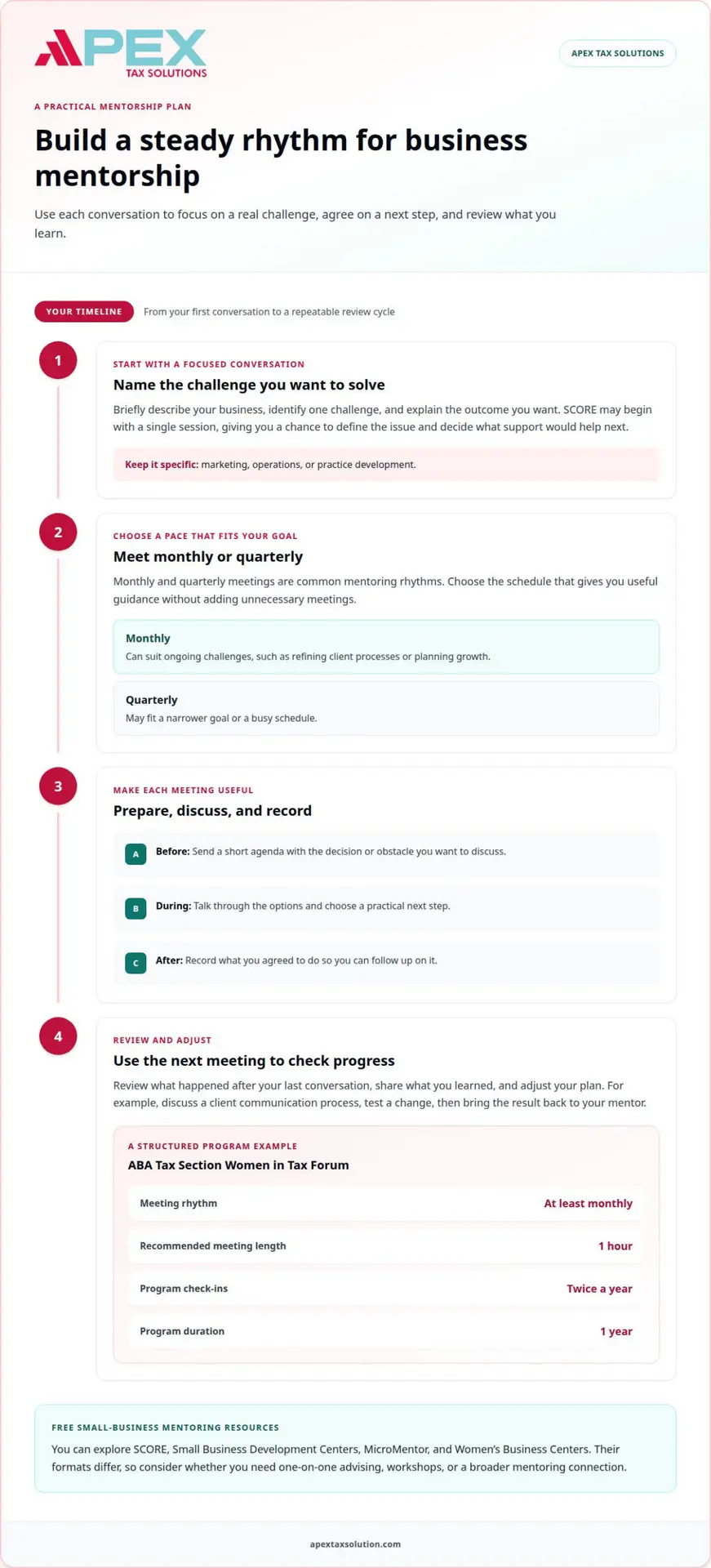
Use a focused onboarding process to make the first conversation productive. Briefly describe your business, name one challenge, and explain the outcome you want. Then agree on communication preferences, boundaries, and a suitable next step. If a community program offers a course or group sessions, use them to build connections alongside one-on-one guidance. SCORE may begin with a single session, so you can start without an upfront long-term commitment.
Meeting frequency and program duration
A useful mentorship schedule gives you regular time to address business challenges without adding unnecessary meetings. Set the rhythm around your goals, the program’s structure, and the work you need to complete between conversations.
The ABA Tax Section Women in Tax Forum recommends that mentor-mentee pairs meet at least monthly. Its program encourages a meeting at least once a month for one hour and checks in with pairs twice a year. The program is structured to support mentees over one year. This example offers a defined cadence: monthly conversations to track progress, with formal check-ins to review how the relationship is working.
Monthly or quarterly meetings are common rhythms for business mentoring. Monthly conversations can suit a tax business owner working through ongoing challenges, such as refining client processes or planning growth. Quarterly meetings may fit a narrower goal or a busy schedule. In either case, share an agenda before each meeting and record agreed next steps afterward. That turns conversation into a working plan.
Free programs can make guidance more accessible to owners managing startup or operating costs. SCORE, Small Business Development Centers, MicroMentor, and Women’s Business Centers are free for small-business owners to use. Their formats differ, so consider whether you need one-on-one advising, workshops, or a broader mentoring connection. A workshop can introduce a topic, while a direct conversation can focus on how it applies to your business.
Some programs begin with a single session rather than requiring a long commitment upfront. SCORE may start with one session, giving you a chance to define a challenge and decide what support would help next. Use the first meeting to identify a specific goal, such as improving client outreach. If you and the mentor find the discussion productive, consider whether follow-up meetings make sense.
Build a repeatable structure for each meeting. Beforehand, send a short agenda with the decision or obstacle you want to discuss. During the conversation, note the options and choose a practical next step. At the next meeting, review what happened and adjust the plan. For a tax practice, that might mean discussing a client communication process, testing a change, and then sharing what you learned.
Program duration should reflect the goal, not just a calendar commitment. A defined program, such as the ABA forum’s one-year structure, can provide continuity, while a focused issue may need fewer conversations. A mentoring relationship can also end naturally once you meet its goals. If your needs change, you can seek a different mentor or use a separate program for the next challenge.
Setting expectations and meeting frequency
Agree on the purpose, boundaries, and working rhythm before mentorship begins. For example, you might focus on improving client onboarding, planning staff training, or preparing for slower months.
Discuss tax compliance questions with a clear distinction between business guidance and professional tax advice. According to the Internal Revenue Service, individuals including sole proprietors, partners, and S corporation shareholders generally must make estimated tax payments if they expect to owe $1,000 or more when filing their return. A mentor can help you identify processes or questions to review, but don’t treat a general business discussion as advice on a specific tax matter.
Set expectations in writing after your first conversation. Record the goal, meeting format, preferred communication method, and what each person will prepare. If your goal is to improve client intake, for instance, bring your current workflow and identify where clients commonly need clarification. Your mentor can then help you examine options and decide what to test.
Choose a meeting rhythm that fits the work between sessions. Monthly or quarterly conversations are common in business mentoring, especially when each meeting has an agenda and follow-up. A monthly check-in can help you track a developing project, while a quarterly review can suit a longer-term planning goal. Use the calendar as a structure, not a substitute for clear objectives.
Map your goals to the tax-business calendar. Before filing season, you might discuss staffing plans, client communications, and workflow preparation. During slower periods, focus on reviewing processes, developing marketing plans, or building staff knowledge. Local business events can also provide timely topics, such as changes in customer needs or community outreach opportunities.
Keep each meeting focused with a simple sequence: name the current challenge, share relevant context, discuss possible approaches, and agree on a next step. For example, if clients often submit incomplete documents, examine how your instructions and reminders work. At the next meeting, report what you changed and the response you observed. This turns mentoring into a practical learning cycle.
Define confidentiality and boundaries early. Decide what business information you’ll discuss, how you’ll handle sensitive client details, and which topics require a qualified tax or legal professional. Avoid sharing identifiable client records in a mentoring conversation. You can discuss a generalized scenario, such as a recurring documentation issue, without exposing private information.
Review the relationship periodically against the goals you set. If you’ve improved a process or completed a growth plan, agree whether to close that goal, choose a new one, or pause meetings. If expectations differ, revisit the agenda and communication plan before continuing. Clear agreements help both people contribute useful knowledge while keeping mentorship focused on your business priorities.
Finding mentors through existing networks
Your existing network can reveal mentors who understand your market and professional context. Start with people who already see how you work, such as colleagues, former instructors, business contacts, or fellow tax preparers. A trusted introduction can make it easier to begin a focused conversation than approaching an unfamiliar owner without context.
Chambers of Commerce may connect members with experienced business owners through mentorship programs or networking. Look at the events and member activities offered by your local chamber. For example, a tax preparer who attends a small-business roundtable can meet owners facing similar staffing or client communication challenges. Follow up with a specific question about the person’s experience, rather than immediately asking for a long-term commitment.
Professional associations can help you build a network around tax work. Their education sessions and member events create opportunities to meet preparers with skills you want to strengthen. If you’re interested in expanding services, for instance, look for an association discussion about practice development. A speaker or participant with relevant experience may become a useful contact after you explain your goal.
Use a simple sequence to turn a new connection into a possible mentoring relationship:
- Identify one business challenge, such as improving client onboarding.
- Find a person in your network with relevant experience.
- Ask for a brief introductory conversation and state what you hope to learn.
- After the conversation, send a concise thank-you and suggest a practical next step.
Your network may also include people outside tax preparation. A business owner could offer insight into hiring, marketing, or customer service, while an experienced tax professional may better understand seasonal workflow. Match the person to the question. For example, ask a marketing contact about reaching small businesses, then seek tax-industry perspective on fitting that outreach into your practice.
Be visible before you need help. Attend chamber events, association education sessions, or business discussions consistently enough to build familiarity. When you share a useful example, such as a client communication process that reduced confusion, other members can understand your strengths and interests. That shared context makes a future mentorship request more specific and easier to answer.
Keep the first request modest. Invite a potential mentor to discuss one business decision, then ask whether they’d be open to another conversation if the exchange proves useful. Explain the challenge, the steps you’ve already considered, and the perspective you need. A clear request respects the person’s time and helps both of you decide whether your experience and goals align.
Use existing relationships carefully. Don’t assume a colleague, chamber member, or association contact has agreed to mentor you simply because they offered advice once. Ask directly about their interest and preferred communication style. If their experience doesn’t fit your current goal, thank them and keep the connection active; a different challenge may make their knowledge relevant later.
Mentorship pricing for team and independent professionals
Mentorship costs depend on the format, scope, access, and expertise you need. Before comparing options, define the business outcome you want. An independent preparer seeking feedback on client communication may need a different arrangement from an office team planning operational changes.
Free mentoring can be a starting point for small-business owners. SCORE and Small Business Development Centers connect entrepreneurs with mentors and advising, while MicroMentor and Women’s Business Centers also offer free programs. These options can help you explore a business challenge without committing to paid, ongoing support. Compare the program’s format and focus with the guidance you need.
Paid arrangements can differ in how mentors deliver support. One-to-one conversations center on your business, while group sessions let participants learn from shared questions and examples. A defined program may include a set curriculum or scheduled meetings; an informal relationship may focus on conversations as needs arise. Ask what the arrangement covers before deciding whether it fits your goals.
For independent professionals, assess value by connecting the commitment to a specific priority. If you want to improve client onboarding, consider whether the mentor will discuss your process, help identify changes, and review what you learn afterward. Clear expectations help you judge whether the time and expense support practical progress and strengthen your confidence in decisions.
Teams should also consider how many people receive guidance and how they’ll apply it. A group format can address a shared topic, such as improving staff communication, while individual sessions can focus on a team member’s responsibilities. Clarify whether the mentor works with the owner, staff, or both, and whether follow-up conversations are included.
Use these questions to compare options:
- Does the program address your stated business goal?
- Is the format individual, group-based, or a combination?
- What preparation, follow-up, or learning materials does it include?
- How does the program handle changes in your priorities?
- What will you use to assess progress, such as a completed workflow or growth plan?
Compare the full commitment, not just the meeting itself. Preparation, follow-up, program duration, and access between sessions can affect the value you receive. A focused discussion may suit a single decision, while ongoing guidance may better support a project that needs review over time. Avoid choosing based on a low headline cost alone.
Ask for clear terms before you register. Confirm the payment structure, cancellation conditions, included sessions, and any additional charges. For team mentorship, clarify whether the arrangement covers the whole group or limits participation. A written summary helps you compare options fairly and avoid mismatched expectations.
Choose the arrangement that matches your needs, available time, and budget. If a free SCORE or Small Business Development Center resource addresses your current question, start there. If your team needs specialized, sustained guidance, compare programs by their focus, access, and outcomes rather than assuming one format suits every tax business.
APEX Tax Solutions
Apex Tax Solutions LLC supports your tax business with software, personalized support, and professional training under one roof. As a Latino-owned business and IRS-authorized e-file provider, it serves tax professionals nationwide with bilingual support in English and Spanish. You can work with a team that prioritizes direct, personalized service rather than call-center scripts.
If mentorship helps you identify ways to strengthen your office, Apex Tax Solutions LLC offerings can help put those plans into practice. Choose APEX Cloud Pro, APEX Corporate Desktop Premium, Wisp & Cybersecurity Training, or the Service Bureau Partner Program based on your business needs. Contact Apex Tax Solutions LLC to discuss the support that fits your goals.
Turn mentoring insights into your next step
Mentor conversations can help you see your business from a fresh perspective. The next step is putting that perspective to work, whether you’re refining an office process, developing your team, or planning for growth. A steady approach to year-round mentorship for tax business owners can keep your learning connected to decisions you make throughout the year.
APEX Tax Solutions supports tax professionals with APEX Cloud Pro and APEX Corporate Desktop Premium. These tools can complement the direction you gain through mentorship as you shape how your tax business operates. Choose support that aligns with your priorities and practice needs.
Build on what you’ve learned and take a practical next step for your business. Contact APEX Tax Solutions to discuss your tax business needs.
Frequently Asked Questions
How do I know if a mentor is a good fit?
A mentor is a stronger fit when their approach suits how you make decisions and lead your business. Notice whether they help you examine tradeoffs instead of prescribing a one-size-fits-all solution. You might ask how they would think through adding a new service. Their response can show whether they respect your priorities and help you reach your own informed conclusion.
How long does a mentor relationship typically last?
Mentor relationships have no universal time limit. A formal program may set a defined participation period, while an informal arrangement can continue as long as both people find it useful. Before joining, review enrollment terms and ask how the program handles renewals or completion. This helps you distinguish the program’s schedule from the longer-term professional connection you may choose to maintain.
How long does it take to see value from mentorship?
Timing depends on the kind of value you’re seeking. You may gain a new perspective during a conversation, while applying it to a business decision takes more time. For example, a discussion about expanding services could help you identify questions to answer before committing resources. Judge value by whether the guidance improves your understanding of the decision, not only by immediate business results.
What year-round mentorship programs are available for tax business owners in the United States?
Options include small-business mentoring networks, tax-industry programs, and entrepreneurship communities such as TiE, which focuses on entrepreneurs, mentors, and investors, particularly in technology and high-growth industries. Tax owners can also explore mentorship through professional associations. Compare the program’s audience and subject focus with your business model. A technology-focused community, for example, may be more relevant if your practice is building technology-led services.
How much does year-round tax business mentorship cost?
There isn’t one standard price for mentorship. Before committing to a paid arrangement, ask how the program calculates its charge and what the payment covers. Clarify whether you pay for participation, individual access, learning materials, or a defined course. Then compare that structure with your budget and intended use. Clear fee terms make it easier to evaluate the commitment without relying on assumptions.
How do I find a qualified mentor for a tax preparation business?
Look for a mentor who understands the type and scale of practice you want to build. An owner managing a team may benefit from someone who has led a professional office, while a solo preparer may prioritize guidance on independent practice decisions. Ask for examples of business challenges they’ve helped address. Their ability to explain the decision process can help you assess whether their perspective fits your circumstances.
What credentials and experience should a tax business mentor have?
No single credential suits every mentorship goal. For business planning, relevant experience may include leading a tax office, managing staff, or developing professional services. For technical tax questions, distinguish business mentoring from specialized tax advice and consider whether the mentor’s qualifications match the subject. A discussion of credentials should clarify what the mentor can address and where another professional’s expertise would be more appropriate.
What are the steps to join and get the most from a year-round mentorship program?
Before enrolling, review the program’s participation terms, meeting format, and expectations for members. If you’re joining with colleagues, decide who will attend and how the group will share useful learning internally. After sessions, translate relevant ideas into a business decision, assigned responsibility, or staff discussion. This helps your team apply the material consistently instead of treating mentorship as an isolated conversation.