
A revenue split works only when the rules behind each payout are clear. Service Bureau Partner Program revenue split structures should define each partner’s responsibilities, how revenue is earned, how referrals are tracked, and how performance is measured. A clear agreement also covers exclusivity, duration, dispute resolution, governing law and jurisdiction, and how amendments are handled.
A fixed fee makes costs easier to predict, while a percentage split ties compensation to revenue. The key is choosing a structure that reflects each partner’s contribution and keeps payouts straightforward to track.
This guide explains how fixed fees and percentage-based splits work, what to include in partner tracking, and which performance measures can help you evaluate an arrangement over time. It also compares how service bureau and tax software reseller models can generate revenue, so you can focus on the terms that matter to your business.
Key Takeaways
- Compare fixed fees with percentage-based payouts to see which better matches each partner’s contribution and cash-flow needs.
- Set clear attribution rules so you can connect referrals and sales to the right partner and calculate payouts consistently.
- Choose performance measures that reflect more than revenue, then review them as costs, demand, or partner responsibilities change.
- Use percentage benchmarks as a starting point, not a substitute for defining the work, risks, and value each party brings.
- Map each revenue stream in your service bureau or reseller model before agreeing on how partners share earnings.
Fixed-dollar fee splits
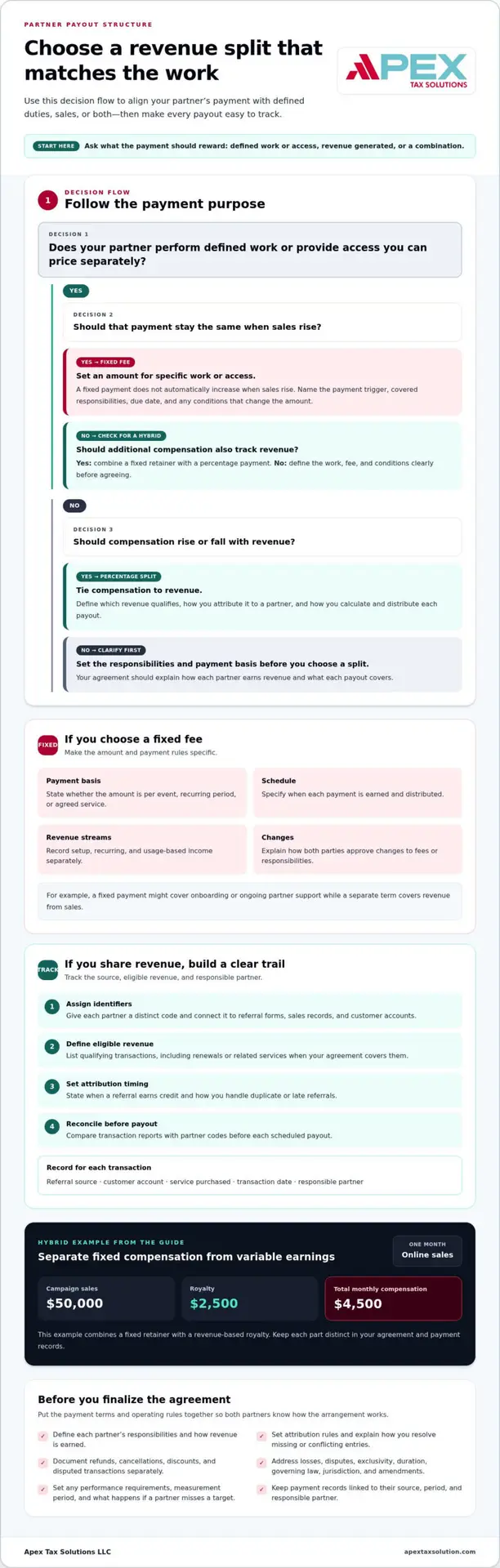
A fixed-dollar payment gives a partner a set amount for defined work or access. Unlike a percentage, it does not automatically increase when sales rise. Your agreement should specify the payment trigger, covered responsibilities, due date, and any conditions that change the amount. These details help both parties forecast cash flow and understand the effect on profit.
How will you divide setup fees, recurring fees, and usage-based revenue? Set a separate rule for each stream: a one-time setup payment might compensate onboarding work, recurring fees can follow a fixed schedule, and usage-based revenue can use a per-use amount or an agreed percentage. Specify who earns each payment and when it is due.
A hybrid arrangement can combine a fixed retainer with a percentage payment. If campaigns generate $50,000 in online sales in one month, the royalty is $2,500, bringing total monthly compensation to $4,500. The example shows why the contract should distinguish fixed compensation from variable earnings.
For a service bureau or software reseller relationship, specify what each fixed payment covers. It might pay for a defined responsibility, such as onboarding or ongoing partner support, while a separate term addresses revenue from sales. Tie fixed payments to specific duties, and explain whether they change if those duties, costs, or the relationship change.
- Define the payment basis: State whether the amount is per event, recurring period, or agreed service.
- Set the schedule: Specify when each payment is earned and distributed.
- Separate revenue streams: Record setup, recurring, and usage-based income independently.
- Document changes: Explain how both parties approve amendments to fees or responsibilities.
Consistent tracking makes reconciliation easier. Each payment record should link the amount to its source, period, and responsible partner. This creates a clear distribution trail, especially when fixed and variable compensation are combined.
Address risk as well as payment. Revenue-sharing terms should explain how the parties handle losses, disputes, exclusivity, duration, governing law and jurisdiction, and amendments. A fixed payment does not resolve these issues on its own. Set out the terms together so the fee, responsibilities, and process for resolving disagreements form a workable agreement.
Revenue attribution and partner tracking
Accurate attribution shows which partner generated a sale, referral, or ongoing engagement. Define the qualifying event before distributing revenue. For example, an agreement might credit a new account to the partner whose referral led to the customer’s first completed purchase. Clear definitions help prevent disputes when multiple partners contribute to the same relationship.
What tax, licensing, and compliance rules affect service bureau partner revenue in the United States? Tax treatment, applicable business licensing, and data-handling responsibilities can affect how partners document and distribute revenue. Specify each party’s role in the agreement, keep payment records organized, and align them with each party’s reporting responsibilities.
Build a consistent attribution process around identifiable events. Record the referral source, customer account, service purchased, transaction date, and responsible partner. If one partner refers a tax office and another supports its software engagement, define whether credit follows the referral, the completed sale, or separate contributions. That rule determines how revenue is allocated.
- Assign identifiers: Give each partner a distinct code and connect it to referral forms, sales records, and customer accounts.
- Define eligible revenue: List which transactions qualify, including renewals or related services when the agreement covers them.
- Set attribution timing: State when a referral earns credit and how you handle duplicate or late referrals.
- Reconcile records: Compare transaction reports with partner codes before each scheduled payout.
Consider a shared prospect who attends a partner event and later contacts your office directly. If records capture only the final contact channel, the original referral can be missed. Document an attribution window and record the first known source to preserve that history. The agreement should also explain how the parties resolve missing or conflicting entries.
Distinguish gross revenue from adjustments that affect the amount eligible for sharing. Record refunds, cancellations, discounts, and disputed transactions separately. A monthly reconciliation can identify mismatches before distribution, while a dated change log shows when an account or attribution record was corrected. Together, these steps create a traceable audit trail.
Use the Service Bureau Partner Program from Apex Tax Solutions LLC as a next step if you want partner support alongside tax software. Before an engagement begins, map referral ownership, eligible revenue, reporting cadence, and each party’s responsibilities. A shared process gives your team a practical foundation for consistent attribution and clearer partner relationships.
Revenue split performance measurement
Evaluate a revenue split against the work, costs, and outcomes each partner contributes. Your agreement can set minimum sales, volume, or performance requirements, but appropriate thresholds depend on the partners’ responsibilities and payout model. Define the measurement period and what happens if a partner misses an agreed target.
Do partners have minimum sales, volume, or performance requirements? The agreement should state whether a minimum applies and how it is measured. Set any threshold alongside the partner’s duties, eligible revenue, and the consequences of falling short.
Choose metrics that reflect the purpose of the relationship. You might assess a referral partner by qualified referrals that become paying accounts, and a reseller by completed sales and renewal activity. A support partner may contribute through response quality or issue resolution, rather than sales volume alone. Match each metric to the work.
Review partner results alongside the economics of the arrangement. Track revenue generated, direct costs, refunds, customer retention, and the time each party invests. A split may appear profitable before support costs or cancellations are included. Compare the same categories in each review period to assess whether the partnership creates lasting value.
- Set a baseline: Record current revenue, costs, and partner responsibilities before changing terms.
- Choose useful metrics: Connect each measure to an action the partner controls.
- Set review timing: Agree when both parties will compare results and discuss adjustments.
- Document changes: Record the reason, approval, and effective date for each amendment.
Market demand can also change a split’s performance. One proposed approach uses a fluctuation of ±15% from baseline as a trigger to adjust the split by 2%. Treat that as a review mechanism, not an automatic rule: define the baseline, data source, and approval process in the agreement before applying an adjustment.
Regularly reassessing the split can help prevent a once-profitable partnership from becoming unprofitable as conditions change. Review the terms when responsibilities shift, costs change, or technology investments affect each partner’s contribution. For example, if one partner takes on new support duties, compare the added workload with revenue and customer outcomes before proposing revised terms.
For a productive review, prepare a shared report showing each metric, source record, calculation method, and review period. Discuss exceptions, such as an unusual cancellation or delayed launch, separately instead of changing the formula without agreement. Clear evidence helps both partners assess results consistently and make amendments through the agreed process.
Revenue-sharing percentage benchmarks
How do service bureau revenue splits compare across major providers? Compare the percentage, revenue base, included responsibilities, and payout conditions, because provider agreements can use different terms. A general benchmark places revenue-sharing percentages from 2% to 10%, depending on stakeholder count and company size.
A percentage range is a reference point, not a universal rate for every tax partnership. A lower percentage may suit a partner with a narrower role, while broader contributions may justify a different allocation. Compare each party’s sales, service, support, and operating responsibilities before deciding whether a percentage is balanced.
Look closely at what the percentage applies to. Define whether revenue sharing is based on gross revenue, eligible revenue after specified adjustments, or revenue from a particular service. For example, a percentage of software sales differs from a percentage of revenue from related services. One unclear definition can change the payout even when both parties agree on the rate.
A separate benchmark illustrates why the revenue source matters: partners may receive 50% of revenue generated when a referred client engages a connected service. That figure applies to the described referral arrangement, not every transaction or partnership. Identify the referred client, connected service, qualifying engagement, and revenue included before using such a model.
Use a calculation example to test proposed terms. A 60/40 split of $100,000 in quarterly shared revenue allocates $60,000 to Company A and $40,000 to Company B. The arithmetic is straightforward, but the agreement still needs to identify which revenue counts, how adjustments affect the pool, and who performs the work.
- Compare contribution: Match each percentage to sales, service, support, and ongoing responsibilities.
- Define the base: Name the revenue stream and explain which adjustments affect the calculation.
- Test a sample: Apply the proposed percentage to a representative transaction or period.
- Review the full terms: Include payout timing, duration, exclusivity, losses, and amendment procedures.
A percentage alone does not show whether a revenue split will work. A partner receiving a larger share may also take on more responsibility or costs. Compare each party’s share with its work, then consider how shared losses and payment timing affect cash flow.
For a useful comparison, list each offer in the same format: percentage, qualifying revenue, partner duties, exclusions, payout schedule, and review process. This helps distinguish a headline rate from the arrangement’s actual economics. A written side-by-side comparison also gives both partners a clear basis for negotiating terms that reflect their contributions.
Set out each party’s responsibilities alongside its share, and account for losses. In a revenue-sharing arrangement, each party is responsible for paying a share of losses.
Service bureau and tax software reseller business models
Your business model determines which revenue streams partners share and what work earns compensation. Compare referrals, software resales, and managed services by tracing each partner’s contribution from customer engagement through payout.
Referral, Reseller, and Managed Service Models
A referral partner introduces a prospective customer, so the agreement can tie compensation to a qualifying referral or resulting engagement. One benchmark gives a partner 50% of revenue when a referred client engages a connected service. A reseller sells software and may earn tiered commissions; a managed service partner takes on continuing responsibilities, so the agreement should connect payment to the services and costs involved.
A tiered reseller example pays 10% on the first $5,000 of new monthly recurring revenue, 15% on the next $10,000, and 20% above $15,000. At $20,000 in new monthly recurring revenue, the payout totals $3,000: $500, $1,500, and $1,000 across those tiers. This structure rewards increased sales while making the calculation visible.
For each model, name the qualifying activity and revenue source. Referral terms should define a completed engagement; reseller terms should specify eligible sales and commission tiers. Managed service terms should describe ongoing duties, costs, and how delivery is evaluated. Do not assume one percentage fits all three models.
Partner Risks Before Joining
Before joining a service bureau program, assess the initial investment, responsibilities, and revenue sources. A service bureau contract may require upfront investment, while seasonal demand can affect cash flow for tax practices that depend on filing-season income. Review how the agreement addresses losses, exclusivity, duration, disputes, amendments, and each party’s responsibilities.
Consider whether your experience and operational knowledge fit the model. Direct tax preparation experience is important when considering a service bureau business for independent tax preparation businesses. Familiarity with the software you plan to resell can help, though it is not required. Clarify how partner duties, software knowledge, and customer support expectations shape your work.
Make your decision using a written comparison. List each revenue source, eligible activity, partner obligation, startup commitment, and payment condition. Then test the terms against both a slow-sales period and a stronger-sales period to see how risk and earnings shift as customer volume changes.
- Referral: Define eligible introductions and the event that earns compensation.
- Reseller: Document sales tiers, qualifying revenue, and commission calculations.
- Managed services: Connect recurring duties, costs, and performance expectations.
Build your tax software reseller model around clear roles and distinct revenue streams. Explore service bureau partner options with Apex Tax Solutions LLC as you shape a partnership that fits your business.
Apex Tax Solutions: TaxSlayer basado en Web
Apex Tax Solutions LLC offers a Service Bureau Partner Program alongside tax software solutions featuring cloud-based technology. The program combines software, support, and training for tax business owners, including competitive service bureau partner program revenue split structures.
As you grow your tax business, personalized support without call-center scripts and bilingual assistance in English and Spanish can help you work through operational needs. Consider how the available software fits your clients and the responsibilities you plan to take on.
Contact Apex Tax Solutions LLC to discuss your service bureau goals and next steps.
Build a Partnership That Can Grow With You
Turn your revenue model into a practical operating plan. Decide which customers you want to serve, what responsibilities you can take on, and how the partnership should evolve as your business grows. Use Service Bureau Partner Program revenue split structures to support that plan, rather than letting payout terms drive it.
APEX Tax Solutions offers TaxSlayer ProWeb and Corp Software for tax professionals considering software alongside a service bureau relationship. Assess how these solutions fit your business model and clients, then set clear expectations for responsibilities, revenue attribution, and performance reviews.
Choose a next step that gives you room to discuss your goals and partnership needs. Discuss your service bureau plans with Apex Tax Solutions and move forward with a structure that fits your business.
Frequently Asked Questions
What Goes Into a Revenue-Sharing Agreement?
Turn the arrangement into a working document both parties can administer. Add a schedule mapping each revenue stream to its source record and calculation owner, then include a sample statement showing how corrections appear in later periods. Before signing, test the schedule against a customer journey, from referral through payment and any later adjustment. This can reveal operational gaps that broad contract language may miss.
What Is a Standard Revenue-Sharing Percentage?
Compare proposals using the same transaction scenario instead of focusing only on the headline rate. Calculate what remains after agreed direct costs, then assess each party’s workload, customer ownership, and ongoing contribution. A rate may look generous but produce a weaker result if it applies to a narrow revenue base. A lower rate may yield more when it applies to a broader base. Record your assumptions before comparing offers.
What are typical revenue split percentages in service bureau partner programs?
For the Sub Service Bureau bonus commission, the amount is $5,000-$20,000 per season. Entry Bonus: $5,000; Top-Tier Bonus: $20,000. Eligibility requires “Minimum 250 funded bank products per season” and “Active EFIN required”. These conditions apply to the bonus commission, so review your funded-product records and EFIN status against the threshold when assessing program participation. The bonus depends on meeting the eligibility requirements.
What costs and expenses are deducted before calculating a partner’s share?
Map costs before calculating a partner’s share. Separate transaction-specific costs from shared operating expenses, then identify which categories the agreement allows you to deduct. For example, assign a transaction-specific charge to that transaction rather than spreading it across unrelated sales. This shows how each deduction affects the calculation and helps prevent general overhead from being treated as an automatic reduction.
What contract terms govern payouts, reporting, renewals, and termination?
Clarify what happens to unsettled earnings when the relationship ends. The agreement can explain how to handle transactions completed before termination but paid afterward, and whether either party retains access to the records needed for final accounting. For renewals, specify how updated terms are documented. These details help your team close out pending activity without confusing it with new business.
How can a partner negotiate a more favorable revenue split?
Prepare at least two workable proposals before negotiating. For example, offer one option with a higher share tied to added responsibilities and another with a lower share but narrower duties. Support each with your expected contribution and operating capacity. This gives both parties room to discuss tradeoffs instead of debating a percentage in isolation. Make priorities such as access to sales records explicit in each proposal.