
What if a stronger tax client base came from steady relationships, not simply more leads? Developing a strong tax client base can feel difficult when inquiries rise and fall with the season, your practice competes for trust, and existing clients already need your attention. Growth works best when you attract clients who fit your services and capacity, then give them reasons to return.
You’re right to focus on more than getting new inquiries. Clear communication, reliable follow-through, and a manageable way to stay in touch can help turn a first appointment into a lasting professional relationship.
This guide shares practical ways to define your ideal clients, build confidence in your services, and create consistent outreach and follow-up habits without overloading your schedule. You’ll also see how dependable operations and organized client communications support sustainable growth.
Apex Tax Solutions LLC supports tax professionals with software, training, and business-growth resources. Its service bureau program offers software setup, dedicated support, and mentorship, while GHL for Tax Offices can help organize marketing and client communications. With the right processes and support, you can build a practice that serves clients well beyond tax season.
Key Takeaways
- Build a client base around service fit and office capacity, not simply a larger contact list.
- Developing a strong tax client base starts with a repeatable marketing process that helps you reach suitable clients and review what’s working.
- Compare referrals, educational content, email, search, and paid campaigns by effort, audience fit, and follow-through needs.
- Map each step from first inquiry to future engagement so clients know what to expect and how to stay connected.
- Assess whether your systems, training, and support can keep pace with your growth goals.
Developing a Strong Tax Client Base Starts With the Right Clients
A long contact list can look like growth, but it doesn’t tell you whether your office can serve those people well. A strong tax client base is a sustainable group of clients whose needs fit your services, communication approach, and capacity, with relationships that can continue over time. Developing a strong tax client base starts with understanding who benefits from your work and where you can provide dependable support.
Client fit matters because each engagement draws on your time and office resources. A prospect may need a type of service outside your scope, have communication needs your current process can’t meet, or expect a workload your team can’t support during a busy period. Clear fit helps you set expectations early and focus your outreach on relationships your practice can maintain.
Keep four groups distinct. Prospects are people considering your services; active clients are currently working with your office; returning clients have chosen to work with you again; and referral sources introduce potential clients but aren’t necessarily clients themselves. Each group calls for different communication, so don’t treat every name in a contact list as an active client relationship.
Identify the clients your tax practice can serve well
Start with what your office can reliably handle: the services you provide, the client situations you understand, your preferred ways to communicate, and the workload your team can manage. Review questions clients often ask and requests that recur. Those patterns can show where your experience is strongest and where clients need clearer explanations.
- Note which services your office handles confidently and consistently.
- Track common questions and points where clients need extra guidance.
- Consider whether your existing process supports clients who prefer digital, phone, or in-person communication.
Use these observations to describe your ideal client by needs and service fit, not by assumptions about age, income, background, or other demographics. Learn about the range of providers involved in professional tax preparation, then compare that broader context with the work your own office actually performs.
Build trust before asking prospects to choose your office
Clear service descriptions help prospects understand what your office does, what information they may need to provide, and what the next step looks like. Explain your process in plain language, and keep your messages consistent across conversations and written materials. Avoid promising outcomes you can’t control; accurate expectations give prospects a sound basis for deciding whether your practice fits.
Make communication accessible, too. If your office supports clients in English and Spanish, let people choose the language that works for them and keep important process details clear in either language. A respectful, understandable exchange helps prospects feel informed before they commit and gives returning clients a more dependable experience.
Trust grows through follow-through. If you tell a prospect when you’ll respond or what information you need next, make that next step clear and communicate consistently. This simple discipline helps you build relationships that match your capacity rather than filling your pipeline with inquiries your office can’t serve well.
How to Attract Tax Clients With a Consistent Marketing Process
Marketing doesn’t need to take over your schedule to make your practice easier to find. A repeatable process helps you focus on suitable prospects, communicate what you offer, and learn which activities deserve your time. For developing a strong tax client base, consistency matters more than trying every channel at once.
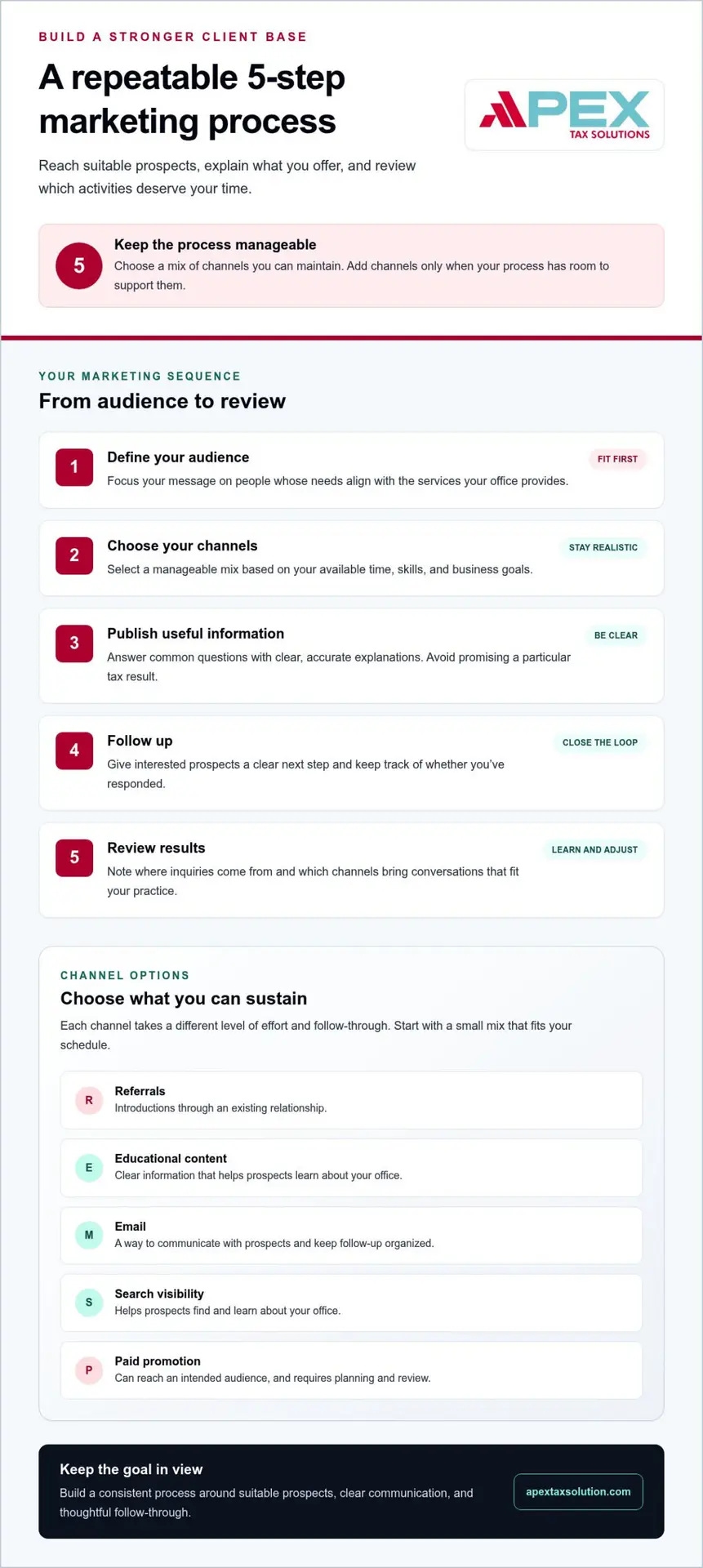
Build your process in this order:
- Define your audience. Use the client profile you’ve established to focus your message on people whose needs align with your services.
- Choose your channels. Select a manageable mix based on your available time, skills, and business goals.
- Publish useful information. Answer common questions with clear, accurate explanations. Avoid promising a particular tax result.
- Follow up. Give interested prospects a clear next step and keep track of whether you’ve responded.
- Review results. Note where inquiries come from and which channels bring conversations that fit your practice.
Choose client-acquisition channels you can maintain
Referrals can introduce you through an existing relationship, while educational content, email, and search visibility help prospects find and learn about your office. Paid promotion can put a message in front of an intended audience, but it requires planning and review. Each channel calls for different effort and follow-through, so start with a small mix you can sustain. Add channels only when your process has room to support them.
Useful tax-season information can demonstrate your knowledge without making outcome promises. For example, explain how a prospective client can prepare for an initial conversation, or clarify the general types of services your office handles. Keep information accurate and direct readers to IRS resources for tax professionals when they need official tax-professional guidance. Helpful content sets expectations; it doesn’t need to make sweeping claims to build confidence.
Create a clear path from first inquiry to conversation
Give prospects one simple next step, such as inviting them to ask whether your office handles the service they need. Record the inquiry source, requested service, and follow-up status in a consistent place. Those details help you see which outreach creates relevant conversations and which inquiries still need a response.
Choose a follow-up routine your team can maintain. A short, courteous message can acknowledge an inquiry, explain the next step, and set a clear expectation for when you’ll respond. For ideas on organizing marketing and office communications, explore GHL for Tax Preparers: The 2026 Guide to Automating Your Tax Practice. A simple tracking habit can keep outreach visible without adding unnecessary complexity.
Review your channel mix at a regular interval that fits your workflow. Keep the approaches that reach suitable prospects and that you can follow through on; adjust or pause the rest. This gives your marketing a practical rhythm, rather than leaving growth dependent on occasional bursts of activity.
Compare Tax Client Acquisition Channels by Fit, Effort, and Follow-Through
A channel can generate attention without bringing inquiries your office can serve. Compare each option by the fit of its audience, the time it takes to maintain, how consistently you can use it, and the follow-up it requires. No channel guarantees a certain volume of clients. As you focus on developing a strong tax client base, measure useful conversations and service fit, not attention alone.
| Channel | Audience fit | Time commitment | Consistency and follow-through |
|---|---|---|---|
| Referrals | People reached through your professional or community relationships | Ongoing relationship-building | Thank referral sources and respond clearly to prospects |
| Educational content | People seeking answers to common tax-service questions | Time to plan, create, and update useful information | Publish regularly and guide readers toward a clear next step |
| People who have chosen to receive updates from your office | Planning and writing relevant messages | Use a steady schedule and handle replies promptly | |
| Search visibility | People looking online for tax services or related information | Ongoing work to keep your online information useful and accurate | Review your information and respond to inquiries that come through it |
| Paid campaigns | An audience defined by your campaign goals and targeting | Setup, monitoring, and adjustment | Review inquiries and spending, then refine or pause as needed |
Match each channel to your business goals
Referrals can suit an established professional network because people who already know your work can introduce your office to others. Educational content can help you answer recurring questions and build familiarity before a prospect reaches out. Email works well for sharing useful updates with an opted-in audience, while search helps people discover your practice as they look for information or services.
Paid promotion may help you test a specific message or reach a defined audience, but it needs a clear goal and regular review. Choose channels based on the time your team can give them and the type of inquiry you want to attract. A small mix you can manage consistently is more useful than a long list of activities that compete with client work.
Use a simple framework to evaluate what is working
Track each channel using the same practical measures: where an inquiry came from, whether it led to a qualified conversation, whether it became a client relationship, and how much staff follow-up it required. A qualified conversation is one where the prospect’s requested service appears to fit your practice. This helps you distinguish activity from progress without assuming that every inquiry has equal value.
Review patterns regularly rather than judging a channel by one response. If a source brings inquiries outside your service scope, adjust its message or audience. If a channel produces suitable conversations but requires more follow-up than your office can sustain, simplify the process before expanding it. If you’re planning a new practice, use the same measures alongside the broader business decisions covered in How to Start a Tax Preparation Business: A Complete Guide.
Turn Tax Inquiries Into Long-Term Client Relationships
A prospect’s first interaction with your office sets expectations for the relationship ahead. A clear, repeatable client journey helps you respond consistently, collect information in an organized way, and keep clients informed after the initial conversation. That structure can reduce avoidable confusion while helping your team manage new inquiries alongside current work.
Create a dependable inquiry and onboarding experience
Give each inquiry a clear next step. A simple workflow can move from acknowledgment to a conversation about the requested service, then to onboarding when the client chooses to proceed. Explain what information you need, how you’ll use it in the process, and what the client can expect next. Avoid leaving people unsure about whether they should wait, send documents, or follow up.
- Acknowledge the inquiry. Let the prospect know you received their message and explain the next step in your process.
- Understand the request. Clarify the service they need and whether it fits your office’s scope and capacity.
- Guide onboarding. Share the information and document-gathering steps the client needs to complete.
- Keep the client updated. Communicate progress or requests for additional information in clear, direct language.
Tax documents contain sensitive personal and financial information. Use an organized process and the secure channels your office has selected for document exchange; avoid asking clients to send sensitive files through an unsuitable communication method. Where applicable, a client portal can give clients a central place to exchange documents and communicate with your office. Explain how clients should use that process so they know where to send information and how to find your updates.
Encourage retention through useful, consistent communication
After onboarding, keep communication relevant to the client’s stage and needs. Share service updates when they matter, follow up on outstanding questions, and make it easy for clients to understand what action you need from them. A useful message has a clear purpose. It doesn’t need to become a constant stream of reminders to show that your office is attentive.
Invite feedback after key interactions. Ask whether the client understood the process and what could have been clearer. Then look for recurring questions. If clients repeatedly ask where to send documents or what happens next, improve the explanation in your onboarding messages rather than answering the same confusion one inquiry at a time.
Workflow tools can help your team organize reminders and communications. The guide Mastering Tax Office Workflow Automation: The 2026 Professional Guide explores this topic further. As your outreach brings in more inquiries, pace promotion to match your capacity. If response times stretch or onboarding becomes difficult to manage, refine the process or slow new outreach until your office can provide dependable service.
For support connecting practice growth with dependable operations, explore APEX business-growth support.
Scale Your Tax Client Base With the Right Support
Growth is easier to manage when your office can support the clients it attracts. Before expanding outreach, check whether your systems, knowledge, and team can handle new inquiries while maintaining the service existing clients expect. Developing a strong tax client base depends not only on outreach, but also on reliable operations behind every client interaction.
Assess your readiness in practical terms. Can your team track inquiries and follow-ups in one consistent workflow? Do you have tax software that fits the returns you prepare, and do staff members know how to use it confidently? Can you communicate clearly with clients and keep work organized during busy periods? Gaps in these areas can signal where added training, tools, or support may help.
Connect client growth to reliable office operations
A consistent workflow gives your team a shared way to manage incoming questions, client updates, and routine communication. For example, you might use a defined process to record an inquiry, assign a follow-up, and keep its status visible. The goal is not to add layers of administration. It’s to make important tasks easier to track as your practice grows.
GHL for Tax Offices is an option for organizing marketing automation and office communications. A tax service bureau can also support practice operations. If you’re exploring how that model works, the guide What Is a Tax Service Bureau? The Professional Guide to Scaling in 2026 offers a useful next step in understanding the topic.
Choose support that addresses a real pressure point in your office. If your team needs help with software setup, look for software support. If staff need to strengthen their knowledge, consider training. If follow-up and communication take too much manual effort, review how your office organizes those tasks before adding more outreach.
Choose support that fits your next stage
Software, tax preparer training, bilingual assistance, and mentorship can work together to support your operations. Software provides tools for preparing returns, while training can help you build skills and use your processes with more confidence. Bilingual support can make communication more accessible for clients who prefer English or Spanish. Mentorship can help you think through business-development decisions as your practice evolves.
APEX Tax Solutions brings software, support, training, and business-growth resources together for tax professionals. Its service bureau program offers software setup, dedicated support, and mentorship. APEX is Latino-owned and has served tax professionals since 2015, bringing a community-oriented perspective to its work with preparers.
Keep your next step focused. Identify the operational challenge that most affects your ability to serve clients well, then look for support that aligns with that need. You don’t have to expand every part of your business at once. Explore APEX Tax Solutions support for tax professionals and consider how the right combination of tools, training, and guidance can support your practice.
Make Your Next Growth Step Deliberate
Your next stage doesn’t need to begin with a major overhaul. Choose one pressure point that’s holding your practice back, such as inconsistent follow-up, limited time to develop outreach, or a workflow that feels difficult to manage. Then set a practical improvement you can put into action and review as your business evolves.
That steady approach keeps growth connected to the experience you want clients to have. As you continue developing a strong tax client base, let your priorities guide which tools, training, and business resources deserve attention. You can build with intention, strengthen your operations over time, and make decisions that fit your team’s capacity.
APEX Tax Solutions brings resources for tax professionals together to support the work behind a growing practice. Explore how APEX Tax Solutions can support your tax practice, and take the next step with confidence.
Frequently Asked Questions
Is a large tax client list the same as a strong client base?
No. A long list may include outdated contacts, one-time inquiries, and people whose needs don’t match your services. Look beyond the number of names: consider whether your clients understand your process, whether your team can serve their needs, and whether relationships continue beyond a single interaction. A smaller, well-managed group may be more sustainable for your office than a larger list you can’t actively support.
Can a tax preparer attract clients outside tax season?
Yes. You can remain visible by sharing useful information and keeping professional communication open beyond filing season. For example, publish answers to common questions about preparing for a future appointment, or share an update about the services your practice handles. Keep your outreach relevant to your actual work and team capacity. A steady, useful presence can help prospects learn about your office before they’re ready to make an inquiry.
How much should a tax preparer spend on marketing?
There isn’t one budget that fits every practice. Start with an amount your business can sustain, then account for both direct spending and the staff time a channel requires. You might begin with a low-cost activity, such as creating helpful content, while setting a defined test budget for paid promotion. Review whether each effort brings suitable inquiries before increasing spending, and adjust based on your business priorities and available resources.
What can a new tax preparer do before having client reviews?
You can build credibility without reviews by clearly explaining your services, experience, training, and client process. Share useful educational information that demonstrates how you communicate, and make your next steps easy to understand. Don’t create or imply testimonials you haven’t received. After completing appropriate client interactions, you can invite honest feedback in a professional way, while respecting each person’s choice about whether to share a public review.
Can bilingual communication help a tax preparer reach more clients?
Yes, if you can communicate accurately and consistently in more than one language, bilingual materials can make your services easier for those clients to understand. Consider translating key process information, appointment instructions, and document requests, not just promotional messages. Use plain language and review translated content carefully so expectations remain consistent. Be clear about the communication you can provide, and make it easy for clients to indicate their language preference.
What should I track to understand whether my client-growth efforts are working?
For developing a strong tax client base, look at whether your efforts attract clients who fit your practice, not just how much attention they receive. Compare inquiry patterns over consistent time periods, and note which service requests align with your expertise and available capacity. Also watch for signs that a channel creates avoidable workload, such as repeated clarification or incomplete inquiries. These details can guide you to refine your message or process.