
Paid tax return preparers filed over 85 million individual tax returns in the United States in 2024, yet there’s no one-size-fits-all revenue split. Terms vary by location, services, workload, and how you and the firm divide responsibilities and costs. The right revenue share opportunities for tax preparers connect your compensation clearly to the work you contribute and the revenue it generates.
If you’re weighing hourly pay, a production-based share, or a seasonal bonus, the details can shape your earnings and working relationship. Compare the terms carefully before deciding which arrangement fits your goals.
This article explains common revenue-sharing structures, what affects commissions and splits, and how related services can create additional revenue opportunities. You’ll also learn how to evaluate an arrangement’s terms and operational support before choosing what suits your tax preparation business.
Key Takeaways
- Compare hourly pay, production-based shares, and bonuses by looking at how each arrangement rewards your work.
- Evaluate a revenue split alongside the costs, responsibilities, and services it covers, not as a percentage alone.
- Referral income can diversify your business, but understand the product, your role, and the rules that apply before making referrals.
- State requirements may affect revenue-sharing and referral arrangements, so identify the rules relevant to where you operate.
- Negotiate clear terms for payment calculations, timing, expenses, client relationships, and changes to the agreement.
How do tax preparation firms structure revenue-sharing arrangements with preparers?
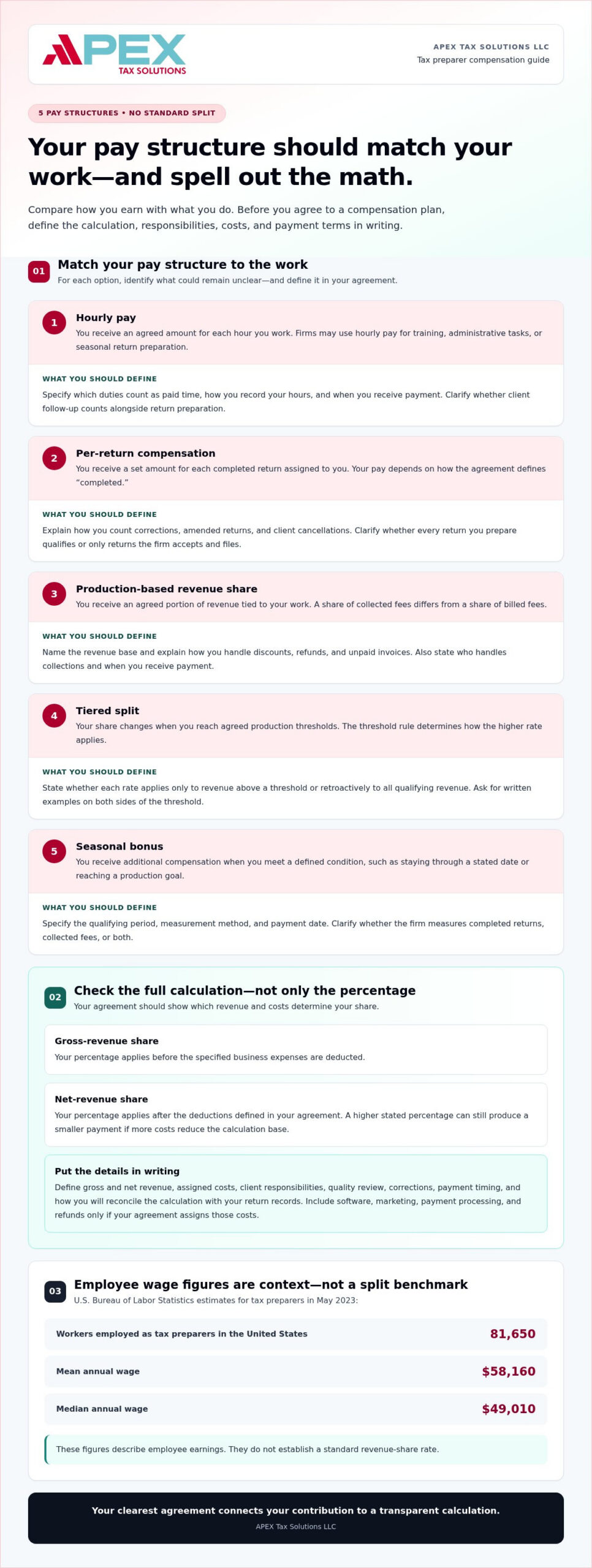
Tax preparation firms commonly pay hourly wages, per-return compensation, production-based shares, or bonuses. Each structure assigns earnings differently, so compare the calculation method with your duties and the firm’s costs. The U.S. Bureau of Labor Statistics estimated 81,650 workers employed as tax preparers in the United States in May 2023. The agency reported a mean annual wage of $58,160 in May 2023 and a median annual wage of $49,010 in May 2023. These wage figures describe employee earnings, not a standard revenue-share rate.
Hourly pay means the firm pays an agreed amount for each hour you work. Firms may use this structure for training, administrative tasks, or seasonal return preparation. Clarify which duties count as paid time, how to record your hours, and when payment is due. For example, ask whether client follow-up is paid as well as return preparation.
Per-return compensation means the firm pays a set amount for each completed return assigned to you. Your agreement should define “completed return” and explain how it handles corrections, amended returns, and client cancellations. Ask whether every return you prepare counts or only those the firm accepts and files. That distinction affects how you track production and reconcile your pay.
Production-based revenue sharing means the firm pays you an agreed portion of revenue tied to your work. Your contract should identify the revenue base, such as collected preparation fees, and explain how discounts, refunds, and unpaid invoices are treated. A share of collected fees differs from a share of billed fees. Payment timing and responsibility for collections also affect the calculation.
A tiered split means your share changes when you reach agreed production thresholds. Ask whether each rate applies only to revenue above a threshold or retroactively to all qualifying revenue. Request a written example using hypothetical return totals. A clear example explains how the threshold works and replaces vague language such as “higher split at higher volume.”
A seasonal bonus means the firm adds compensation when you meet a defined condition, such as staying employed through a stated date or reaching a production goal. Your agreement should specify the qualifying period, measurement method, and payment date. Ask whether the firm measures completed returns, collected fees, or both. That tells you exactly what earns the bonus.
Also define gross revenue, or revenue before deductions, and net revenue, or revenue after specified deductions. Include software, marketing, payment processing, and refunds only if your agreement assigns those costs. Clarify who handles client communication, quality review, and corrections. Ask for a written schedule showing how your share is calculated, reported, and paid, so you can reconcile payments with your return records.
What commission rates or revenue splits do tax preparers typically earn?
A commission rate is the portion of qualifying revenue paid to you for the work you produce. There is no standard rate across tax firms. A community commenter notes that preparer pay varies by location, so an arrangement in one market may not reflect another. Your role, experience, workload, and the firm’s contribution also shape the terms. That is why revenue share opportunities for tax preparers differ from one practice to another.
A revenue split is an agreed division of preparation revenue between you and the firm. One tax practice owner said they started new preparers at 25% of what they produced several decades ago. Treat that figure as a historical example, not a current standard or a recommendation. It doesn’t establish what preparers typically earn today.
Gross-revenue share means your percentage applies before specified business expenses are deducted. Net-revenue share means it applies after the deductions defined in your agreement. Compare both calculations using the same return and fee scenario. A higher stated percentage can still produce a smaller payment if more costs reduce its calculation base.
Effective compensation means what you receive in relation to the work and responsibility you contribute. To assess it, map the full workflow: who attracts the client, gathers documents, prepares the return, answers follow-up questions, and handles corrections. If you manage most stages, compare that workload with an arrangement in which the firm supplies clients, software, review, and administrative support. This helps you assess revenue share opportunities for tax preparers based on the full arrangement, not just its headline rate.
Before accepting a quoted split, request a written calculation example showing the revenue counted, permitted deductions, your share, and payment timing. Then ask how the firm handles discounts, unpaid invoices, refunds, and jointly prepared returns. Each answer can change the calculation, even if the stated percentage stays the same.
Tiered commission means different portions of production may receive different rates after an agreed threshold. The agreement should explain whether the higher rate applies only to revenue beyond that threshold or to all eligible revenue. Ask for examples on both sides of the threshold to see whether the structure rewards additional production as you expect.
Before deciding, compare each offer’s calculation base, assigned costs, duties, payment schedule, and review process. Compare like with like, especially when one firm supplies clients and another expects you to bring your own. The offer that best fits your circumstances is the one whose written terms clearly connect your share to your contribution, responsibilities, and the firm’s support.
How can tax preparers earn referral fees from financial products or other services?
A referral fee is compensation for connecting a client with a provider or service. You can explore this model by identifying client needs outside your tax preparation work. For example, a small-business client may ask about insurance after discussing business income. Selling insurance through major insurance agencies is one way tax preparers can diversify. Before pursuing this arrangement, define whether you introduce prospects, explain products, or actively sell them.
A referral partnership is an arrangement in which you direct a client to a separate provider under agreed terms. Start by identifying a provider whose service fits your clients’ needs, such as an insurance agency. Then document what counts as a completed referral, how it is tracked, and when compensation is due. A named contact and written reporting process can help you reconcile referrals with payments.
A referral fee is compensation tied to a qualifying introduction or transaction. The agreement’s trigger may be a client meeting, an application, or a completed purchase. Ask the provider to explain the trigger in plain language. If a client receives an introduction but does not proceed, for example, the agreement should say whether that referral qualifies.
Product sales involve a more active role than simply introducing a client. Selling insurance through major insurance agencies is one diversification route for tax preparers. Before choosing this model, clarify who explains coverage, handles applications, and answers product questions. Keep tax preparation and product conversations distinct so clients understand which service you’re discussing.
Client disclosure means clearly explaining your relationship with the provider and whether you may receive compensation. Make the disclosure before the referral, using direct language. For example, tell the client you may receive compensation if they proceed with the referred provider. Record what you disclosed, when you made the referral, and which provider received it.
Referral tracking means recording introductions and matching them to the provider’s payment report. With the client’s consent, use a simple log containing the referral date, provider, service category, and outcome. Avoid recording unnecessary tax details. Reconcile the log with provider statements and resolve missing entries through the contact named in your agreement.
Before launching a referral channel, take these steps:
- Identify a client need and a suitable provider category, such as insurance.
- Define your role, qualifying referral, calculation method, and payment timing in writing.
- Explain the relationship to clients and maintain a consistent referral record.
- Review the arrangement against applicable requirements before recommending or selling financial products.
A clear process helps you assess whether referrals complement your tax work without distracting from accurate preparation and client service.
Are there state laws restricting revenue sharing or referral fees for tax preparers
A state-law review checks the rules relevant to your compensation arrangement in each applicable jurisdiction. The answer depends on the service, your role, and where you and the client operate. An insurance referral is not necessarily treated like a referral for another service. Start by identifying the product, who sells it, and how you earn compensation.
A referral arrangement is an agreement connecting a client with another provider. To assess it, identify each party’s role: do you introduce the provider, discuss product options, or help complete a sale? Then review the rules that may apply to that activity in your state. A referral-only role and a sales role can raise different questions, so describe your actual conduct accurately.
A professional licensing check determines whether your activities require credentials for the product or service involved. If you plan to sell insurance through an agency, for example, separate tax preparation from insurance sales in your process. Identify who explains coverage, accepts applications, and answers client questions. Then determine whether your role requires authorization under the rules governing that product in the relevant state.
A fee-sharing review examines whether the payment method in your agreement is permitted for the work performed. Review the terms for a flat referral payment, a percentage of a transaction, or compensation tied to a completed sale. For each method, record who pays you, what triggers payment, and what activity you perform. This helps distinguish payment for an introduction from compensation for selling or advising.
A disclosure review checks what clients should know about your financial relationship with a referred provider. Draft a plain-language explanation naming the provider, describing your role, and stating whether you may receive compensation. Use the same disclosure before referrals and retain a record of when you provided it. Also check whether state rules address client consent, referral arrangements, or handling client information.
Federal requirements provide a separate baseline: according to the Internal Revenue Service, all paid tax preparers in the United States must have and use a Preparer Tax Identification Number (PTIN). That requirement does not answer whether a particular state restricts a referral fee. Keep the PTIN requirement distinct from your state-by-state review.
Use this practical sequence before adopting an arrangement:
- List each state where you prepare returns, refer clients, or conduct product sales.
- Name the service, provider, payment trigger, and tasks you perform.
- Review applicable state rules for licensing, fee sharing, disclosure, and client information.
- Keep the written agreement and client disclosures consistent with your actual activities.
This process helps you identify the specific issue to resolve before adding a referral revenue stream to your tax practice.
State regulation can impose separate entry requirements for other professions: real estate brokers in the United States must meet education requirements set by state laws and pass a broker’s license exam. In the United States, the IRS has authority to regulate the practice of tax practitioners but generally lacks authority to regulate unenrolled paid preparers. The United States has 127k businesses in the tax preparation services industry in 2026, while 886,338 individuals had current preparer tax identification numbers (PTINs) for 2026.
How do independent tax preparers negotiate revenue-share agreements with firms
A revenue-share agreement is a written contract defining how you and a firm divide eligible preparation revenue. Before discussing a percentage, map your role from client intake through return delivery. Note which tasks you perform and which the firm provides, such as marketing, software, review, or administrative support. This gives both parties a concrete basis for negotiation.
A negotiation baseline documents the work and resources each party contributes. Prepare a sample workflow for a typical client, including document collection, preparation, client questions, and corrections. Mark who handles each task. If you bring the client and manage follow-up, explain how that differs from a firm supplying the client and handling office operations.
The revenue base is the amount used to calculate your share. Ask whether the calculation uses fees billed or fees collected, then define deductions in writing. If a client receives a discount, for example, the agreement should state whether your share is based on the original fee or the reduced amount. Clarify how refunds, unpaid invoices, and jointly prepared returns affect the calculation.
A payment schedule states when the firm calculates and pays your share. Agree on a regular reporting cycle and request a statement listing eligible returns, revenue counted, deductions, and your resulting payment. Set a process for correcting a missing return or calculation error. A sample statement can reveal unclear terms before the agreement takes effect.
A review clause sets when you and the firm revisit the terms. Tie the discussion to a defined event, such as a change in your duties, client sources, or review responsibilities. If the firm adds client intake work, for example, discuss whether compensation should reflect that additional task. Specify how both parties approve and record changes.
Client ownership terms explain who manages relationships and records if your working arrangement ends. Define who can contact clients, access relevant records, and continue serving accounts, consistent with applicable requirements. Discuss these terms before accepting referrals or bringing your own clients. Clear language can prevent a payment dispute from becoming a separate disagreement about ongoing client service.
Use this negotiation sequence before signing:
- List your duties and the firm’s contributions for each stage of return preparation.
- Request written definitions for eligible revenue, deductions, payment timing, and corrections.
- Review sample calculations and statements against realistic client scenarios.
- Record approval, review, and client relationship terms in the final agreement.
For practical support as you build your tax business, explore tax practice support with Apex Tax Solutions LLC.
Ensure your agreement clearly defines payment timing and reporting, and document who can approve adjustments. Bookkeeping can provide tax preparers with a year-round service offering and may be an add-on for clients whose business taxes they already prepare. Tax preparers can add revenue by providing tax preparation services to accounting firms that outsource the work.
The United States had 26,256 tax preparers with attorney credentials, 209,076 tax preparers with certified public accountant credentials, and 71,966 tax preparers with enrolled agent credentials. These figures describe the range of credentials in the profession, but an agreement should still specify your responsibilities and compensation. In the United States, tax preparers who provide financial services that are not solely fee-based need securities licenses and a relationship with a broker-dealer.
Apex Tax Solutions: TaxSlayer basado en Web
Apex Tax Solutions LLC offers web-based solutions and the Service Bureau Partner Program to support your tax preparation business. If you’re considering software and business support, explore options that fit your practice:
- Web-based Professional Software
- Service Bureau Partner Program
- Corp Software
- Wisp & Cybersecurity Training
Contact Apex Tax Solutions LLC to discuss which option aligns with your practice.
Build a Tax Practice That Can Grow With You
Turn your priorities into a practical plan for your tax practice. As you assess revenue share opportunities for tax preparers, decide what you want your role, client relationships, and business growth to look like. Use those priorities to guide your next business decision.
Choose an approach that fits your goals and how you want to serve clients. A thoughtful plan can help you stay focused as your practice develops.
When you’re ready to discuss your next step, contact the team. Keep building at a pace that works for your business and your clients.
Frequently Asked Questions
What revenue-sharing opportunities are available for tax preparers in the United States?
In the United States, you can earn through firm-based compensation, referrals, or a service-bureau arrangement. For example, Apex Tax Solutions’ Service Bureau Partner Program includes software license fees, service-bureau fees per bank product, and volume-based bonus commissions. To qualify for a bonus, partners need an active IRS EFIN, a signed Sub Service Bureau agreement, and at least 250 funded bank products per season. These channels let you consider income beyond preparing individual returns.