
What happens to a promising tax lead after they fill out your form? Tax business marketing funnels help you track each prospect through clear stages: initial question, follow-up, discovery call, and decision. When every lead has a recorded source, need, next step, and outcome, you can see who needs attention and where prospects stop moving forward.
A spreadsheet or inbox may seem sufficient at first. But when inquiries come through several channels, scattered notes make timely follow-up harder and obscure which messages help prospects take the next step.
This guide explains how to organize leads and nurture them without sending every prospect the same generic sequence. Learn how to match useful content to buyer questions, plan follow-up, prepare for discovery calls, and track whether opportunities progress. A CRM pipeline can bring lead activity into one practical view, helping you make informed decisions about marketing and client conversations.
Key Takeaways
- Give each prospect one clear next step, such as scheduling a conversation or sharing contact details.
- Organize useful content around the questions prospects ask, so they can understand how your services may fit their needs.
- Tailor follow-up messages to each lead’s interests instead of relying on one generic sequence.
- Use discovery calls to understand a prospect’s needs, assess fit, explain your offer, and agree on next steps.
- Offer a low-pressure first step, such as a checklist, quiz, or consultation, to help interested prospects begin a conversation.
Calls to action and appointment scheduling
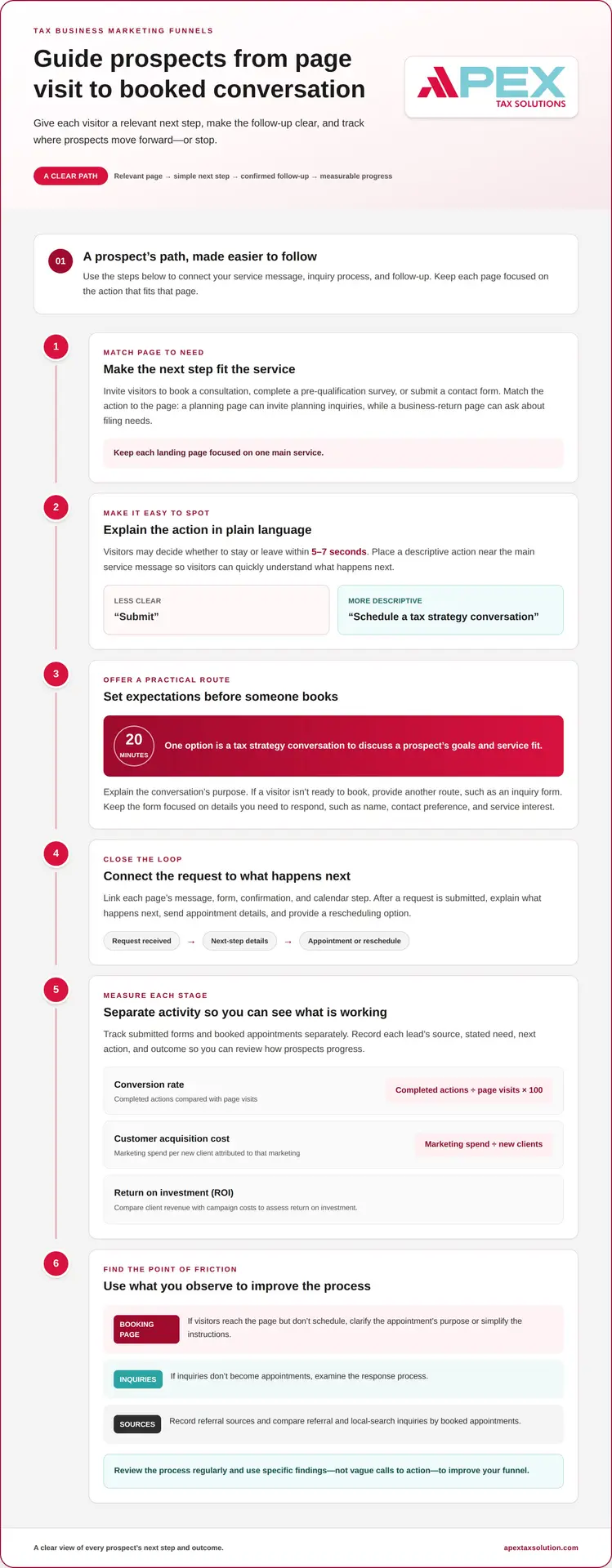
A clear call to action gives each visitor one practical next step. Your tax firm’s website might invite visitors to book a consultation, complete a pre-qualification survey, or submit a contact form. Match the action to the page: a planning page can invite planning inquiries, while a business-return page can ask about filing needs.
Make the action easy to spot. Visitors may decide whether to stay or leave within 5-7 seconds. Place a descriptive button near the main service message. “Schedule a tax strategy conversation” explains more than “Submit.” Keep forms focused on details needed to respond, such as name, contact preference, and service interest.
One option is a 20-minute tax strategy conversation. Explain its purpose, such as discussing a prospect’s goals and service fit. If visitors aren’t ready to book, offer another route, such as an inquiry form. Tax business marketing funnels work best when each page presents a relevant next step.
Connect each page’s message, form, confirmation, and calendar step. After a request is submitted, explain what happens next, send appointment details, and provide a rescheduling option. Track incomplete booking attempts separately from completed appointments to see where interested prospects leave the process.
- Use button labels that describe the next action.
- Keep each landing page focused on one main service.
- Confirm every form submission or appointment booking.
Describe your services and qualifications accurately. Don’t imply affiliations, approvals, or outcomes you can’t substantiate. Use testimonials that reflect real client experiences without suggesting every prospect will have the same experience. Clear descriptions help visitors understand your offer before booking.
Measure each stage with consistent definitions. Calculate conversion rate by dividing completed actions by page visits, then multiplying by 100. Track submitted forms and booked appointments separately. Calculate customer acquisition cost by dividing marketing spend by new clients attributed to that marketing. Compare client revenue with campaign costs to assess return on investment, or ROI.
Local firms can connect search intent and referrals to matching pages. Use relevant local references and your actual service area in page copy. Keep business details consistent across listings. Ask referral partners to share a dedicated inquiry link, then record that source in your lead system. Compare referral and local-search inquiries by booked appointments.
Review the process regularly. If visitors reach a booking page but don’t schedule, clarify the appointment’s purpose or simplify the instructions. If inquiries don’t become appointments, examine the response process. Use specific findings to improve tax business marketing funnels, rather than relying on vague calls to action.
Content organized around buyer questions
Build each page around a question your prospective client already has. A tax marketing funnel can organize content across awareness, consideration, and decision stages. At awareness, explain a problem in plain language. At consideration, show how your process addresses it. At decision, clarify what to expect from an initial conversation.
Start with questions from actual inquiries, calls, and referral conversations. Group them by topic, such as tax planning, filing responsibilities, or finding support for a business. Match each question to a useful format: a short explainer can answer a basic concern, while a detailed service page can clarify who a service is for.
For example, a construction company with about $4 million in annual revenue might ask about proactive tax planning. A useful page should first address that concern, explain what information a planning discussion may cover, and clarify the next step. It should not begin with a long list of firm services. That order helps a visitor understand relevance before deciding whether to inquire.
Address concerns directly without overstating outcomes. A landing page can explain what a prospect can do if they’re concerned about IRS penalties or missed deductions. Describe the issue clearly and explain the kind of professional support the page covers. Don’t imply that a particular outcome is assured or that every reader has the same situation.
Use a simple workflow to turn recurring questions into content:
- Collect questions from consultations, emails, and intake forms.
- Group questions by prospect type and decision stage.
- Choose one main question for each page or resource.
- Answer it before introducing related services.
- Link the answer to a relevant next step.
Specificity makes expertise easier to recognize. If your firm serves a defined client group, explain that focus with relevant examples. For instance, a page for independent contractors can address how business structure may shape the questions they bring to a tax professional. Don’t claim a specialty unless your services and experience support it.
Review content as questions change. Compare inquiries from a planning page with those from a filing page. Note the concerns prospects raise in conversations, then update each page to answer them clearly. This keeps your resources connected to real buyer needs instead of broad, generic tax language.
Keep the message consistent from the first answer through the service explanation. A prospect who reads about planning should find a next step related to planning, not an unrelated offer. That connection guides people through their decision while setting clear expectations about what happens next.
Marketing automation and lead nurturing
Automation helps organize follow-up after a prospect makes contact. Record each lead’s source, stated need, and next action, then tailor messages to those details. Someone asking about an individual return needs different information from a business owner exploring tax planning.
Individual tax-preparation leads may need information about the filing process. Small-business tax prospects may want guidance about business returns or planning. Bookkeeping inquiries need a separate path focused on bookkeeping, not tax-preparation messages. Match each sequence to the service the prospect actually asked about.
Respond promptly when a lead requests contact. Funnel guidance cited for this topic says businesses are 100 times more likely to connect when they contact a lead within the first five minutes. Set an alert for new inquiries, assign an owner, and record the response. Use the prospect’s stated contact preference.
Build follow-up around the prospect’s question, not a fixed calendar alone. A 30-day drip sequence may suit one campaign, but it shouldn’t become every lead’s default. Send useful information after an inquiry, then adapt later messages to the prospect’s interest or reply. Pause the sequence when the person responds.
Email nurturing can explain your firm’s philosophy, share relevant case studies, clarify tax issues in plain English, and show your approach. For example, a prospect interested in planning might receive a short overview of your process, followed by a relevant case study. Keep each message focused on one useful point and one next step.
For email and SMS outreach, send truthful, relevant messages that match the prospect’s request. Identify your business clearly, avoid unsupported claims, and provide an easy way to stop receiving messages. Honor opt-out requests and record contact preferences. Make these practices part of your review process instead of assuming one message fits every situation.
Automation costs depend on the tools you choose, the workflows you build, and the time needed to maintain them. Estimate setup, content creation, integrations, and staff oversight separately. A simple system may need fewer moving parts than one connecting multiple intake forms, email sequences, and lead records.
Common mistakes include sending irrelevant messages, requesting unnecessary information, and failing to record replies. Review each workflow from form submission to final outcome. Remove messages that no longer match the prospect’s stated need, and stop follow-up when someone declines further contact.
- Tag leads by service interest and inquiry source.
- Assign someone to monitor new submissions and replies.
- Use relevant messages instead of one default sequence.
- Record contact preferences, opt-outs, and outcomes.
Review results by lead type and message. If business owners respond to planning content but ignore filing reminders, adjust that sequence. Apex Tax Solutions LLC Service Bureau Partner Program supports tax professionals seeking broader business support. Keep every automated step useful, accurate, and connected to the prospect’s stated interest.
Discovery calls and closing processes
A discovery call should clarify the prospect’s needs before you recommend a service. Ask what prompted the inquiry, which tax questions they want addressed, and what outcome matters to them. For example, a business owner may need help understanding which tax services fit their situation. Listen first, then summarize the concern in plain language.
Use the conversation to confirm whether your services fit the prospect’s needs. A useful call covers four steps: clarify the pain point, confirm alignment, present a relevant offer, and define next steps. If the prospect needs a service outside your scope, say so clearly instead of forcing a poor fit.
Keep the discussion focused with a simple agenda:
- Confirm the prospect’s main concern and reason for reaching out.
- Ask what they’ve tried and where they need support.
- Summarize their needs and confirm you understood correctly.
- Explain the service that best matches those needs.
- Agree on a next step, owner, and follow-up date.
If a prospect asks about business tax support, first clarify the type of help they need, then describe your process. Don’t promise a specific tax outcome. Explain what your service covers and what information you’ll need to determine a practical next step.
After the call, record its outcome in your customer relationship management system, or CRM. A CRM pipeline can track deal value, scheduled calls, no-shows, and won or lost opportunities. Add brief notes about the prospect’s needs, questions, service interest, and agreed follow-up. These details help you continue the conversation without asking them to repeat themselves.
Use clear pipeline stages, such as inquiry received, call scheduled, call completed, proposal shared, and decision pending. Move each prospect forward when an action occurs, not simply because time passes. If someone misses a call, record the no-show and follow up with a concise rescheduling option.
Define what “won” and “lost” mean for your firm. A prospect becomes won when they accept your offer and take the agreed onboarding step. Mark an opportunity lost when they decline, choose another path, or stop responding after your follow-up process. Record the reason if the prospect shares it, such as timing or service fit.
Review the pipeline regularly. Compare scheduled calls with completed calls, then completed calls with accepted offers. If prospects often ask the same question before deciding, update your call notes or service explanation. These patterns show where your process needs more clarity, and recorded outcomes help you plan the next conversation.
What are the best lead magnets for tax preparers and tax accountants?
A useful lead magnet solves one small problem before inviting a sales conversation. For a tax firm, it might be a checklist, a short quiz, or a no-obligation consultation. Choose a format that fits the prospect’s question and provides a practical next step.
A checklist works well when prospects need to organize information or understand a process. For example, create a guide to preparing for an initial tax-planning discussion. Keep it focused on general preparation, explain unfamiliar terms, and don’t present it as a personalized tax recommendation.
A quiz can help prospects identify which topic they want to discuss. Ask simple questions about their goals, such as whether they need help with an individual return or business tax planning. Use the result to suggest relevant information, not to promise a particular tax outcome.
A consultation offers a direct conversation for people who prefer personal guidance. Explain its purpose before someone books, such as discussing their concerns and whether your services may fit. Keep the first step low-pressure, and clarify what the conversation will and won’t cover.
Match each offer to a clear audience and page:
- Checklist: Help new prospects prepare questions for a tax professional.
- Quiz: Guide visitors toward relevant service information.
- Consultation: Give interested prospects a chance to discuss their needs.
Make the exchange worthwhile. A visitor who downloads a checklist should receive the promised resource, not an unrelated sales pitch. A short follow-up can offer a related explanation or invite them to continue the conversation. Keep the message connected to the resource they chose.
Ask only for information that helps deliver the offer or respond appropriately. A checklist download may require just an email address, while a consultation request may need a preferred contact method and a brief description of the concern. Don’t request sensitive tax documents through a basic marketing form.
Build the landing page around one offer. State who it helps, what the prospect receives, and what happens after submission. For example, a business tax-planning checklist should identify its intended audience and contents, then use a button such as “Get the checklist.” Avoid combining several unrelated offers.
Track each offer’s results by source and next action. Record downloads, quiz completions, consultation requests, and later appointments separately. If a checklist attracts visitors but few continue, refine its topic or follow-up. A strong lead magnet starts a relevant conversation instead of collecting contacts without context.
APEX Tax Solutions
APEX Tax Solutions supports tax professionals with tools and services for managing leads and serving clients. If you’re refining follow-up workflows or growing your practice, its Service Bureau Partner Program offers software setup, dedicated support, and year-round mentorship. You can also explore professional tax software, cybersecurity training, and GHL tools for tax offices.
The right next step depends on where you need support. You might be strengthening office systems, choosing tax software, or building skills to support your team. Explore APEX Tax Solutions’ software, training, and business support to find an offering that aligns with those priorities.
Contact APEX Tax Solutions to discuss support for your tax business.
Put your next growth step into motion
A lead process works best when it reflects how you want to serve clients and grow your tax business. Use insights from your tax business marketing funnels to choose one improvement that fits your priorities, then build on it as you learn which approaches bring the right prospects forward.
APEX Tax Solutions offers professional tax software, including APEX Cloud Pro and APEX Corporate Desktop Premium. These options can support different business needs as you develop your practice. Consider which best aligns with how you want to work and the clients you aim to serve.
You don’t need to redesign every part of your marketing at once. Start with a clear goal for your lead process and explore the support that fits your next step. Contact APEX Tax Solutions today to discuss your tax business goals.
With a thoughtful approach and the right tools, you can keep building a practice that serves clients confidently.
Frequently Asked Questions
How Do I Keep Track Of My Accounting Firm Leads?
Use one customer relationship management system, or CRM, as your central lead record. Assign each inquiry an owner and capture its source, service interest, last interaction, next action, and outcome. If a referral and a returning client submit separate forms, merge duplicate records while preserving both source details. Review overdue follow-ups at the start of your workday, then update each lead’s record after a conversation.
How do I build a sales funnel for my accounting firm?
Build your funnel by defining whom you want to serve, what problem you solve, and how prospects can take a first step. Map the path from a relevant article or referral to a useful resource, a conversation, and an accepted engagement. For example, a firm serving independent contractors could connect a tax-planning article to a focused guide, then tailor follow-up to the reader’s stated interest.
What should be the primary goal of a discovery call with a new lead?
Your primary goal is to determine whether the prospect’s needs align with your services. Ask what prompted their inquiry, what they hope to address, and what they expect from professional support. Then explain your service boundaries and agree on a specific next action. A discovery call should help both sides make an informed decision, not pressure someone into accepting an offer before understanding whether it fits.
Why is my accounting website getting traffic but no new clients?
Traffic may come from visitors whose needs don’t match your services, or your pages may leave them unsure what to do. Compare the search terms and referral sources bringing visitors with the services featured on those landing pages. Then check whether each page explains its audience, offers a relevant next step, and works smoothly on mobile devices. A mismatch can interrupt an otherwise promising visit.
What is a marketing funnel for a tax preparation business?
A marketing funnel is a planned path that helps a prospective client move from first learning about your tax business to deciding whether to work with you. It connects marketing touchpoints, such as a referral, educational resource, or service page, with follow-up and a decision. For example, someone who reads about business tax services can receive information related to that interest before discussing an engagement.
How do tax firms attract leads at each stage of a marketing funnel?
At the early stage, attract attention with useful explanations that answer common tax questions. For prospects comparing options, provide service details, examples of your process, and clear information about whom you help. At the decision stage, explain how to start a conversation. A firm serving small businesses, for example, can tailor each touchpoint to the questions those owners raise.
How can tax businesses convert website visitors into consultation bookings?
Explain what a consultation covers, whom it helps, and what information to have ready. Keep booking straightforward, with a clear confirmation and appointment details after submission. If someone isn’t ready to book, offer a relevant alternative, such as an inquiry form or educational resource. Track which pages and referral sources lead to completed bookings, not just button clicks.
What email and SMS follow-up sequences work for tax service leads?
Make follow-ups relevant to the prospect’s request: acknowledge the inquiry, share useful information, and provide a clear next step. For example, an email lead asking about business tax services could receive a service overview, followed by a message addressing a related question. Use SMS only when the person has agreed to receive texts. Keep messages relevant, and stop when they opt out or no longer want contact.