
A tax office’s tax risks can begin far beyond a tax return. A tax office risk assessment and management approach identifies, evaluates, and prioritizes threats to compliance, reporting accuracy, and regulatory obligations, including risks tied to cybersecurity, cross-border activity, and business changes. A security gap can put sensitive taxpayer information at risk, while a new location or operating model can change the tax issues a small firm needs to consider.
You may already review returns and protect client records as part of daily work. The challenge is bringing those tasks together to see what could go wrong, how serious the impact might be, and which controls can reduce exposure.
This article explains tax risk assessment and how to apply it in a small tax office. You’ll learn how to assess multi-jurisdictional activity, revisit policies when your business changes, manage compliance work, and include cybersecurity in your risk plan. The aim is a practical framework for informed decisions that keeps tax and data-protection responsibilities in view.
Key Takeaways
- Map where your business operates and how cross-border activity, remote staff, or changing business models could affect tax obligations.
- Assess each tax risk by considering its likelihood and potential impact, then prioritize the issues that could most affect compliance or financial reporting.
- Revisit tax policies when laws, operations, technology, or staff responsibilities change so your controls stay relevant.
- Use regular monitoring, documented decisions, and compliance reviews to spot process gaps and address them early.
- Include taxpayer data, access controls, and staff training in your cybersecurity risk assessment; Wisp & Cybersecurity Training can support that focus.
Risks from cross-border and multi-jurisdictional operations
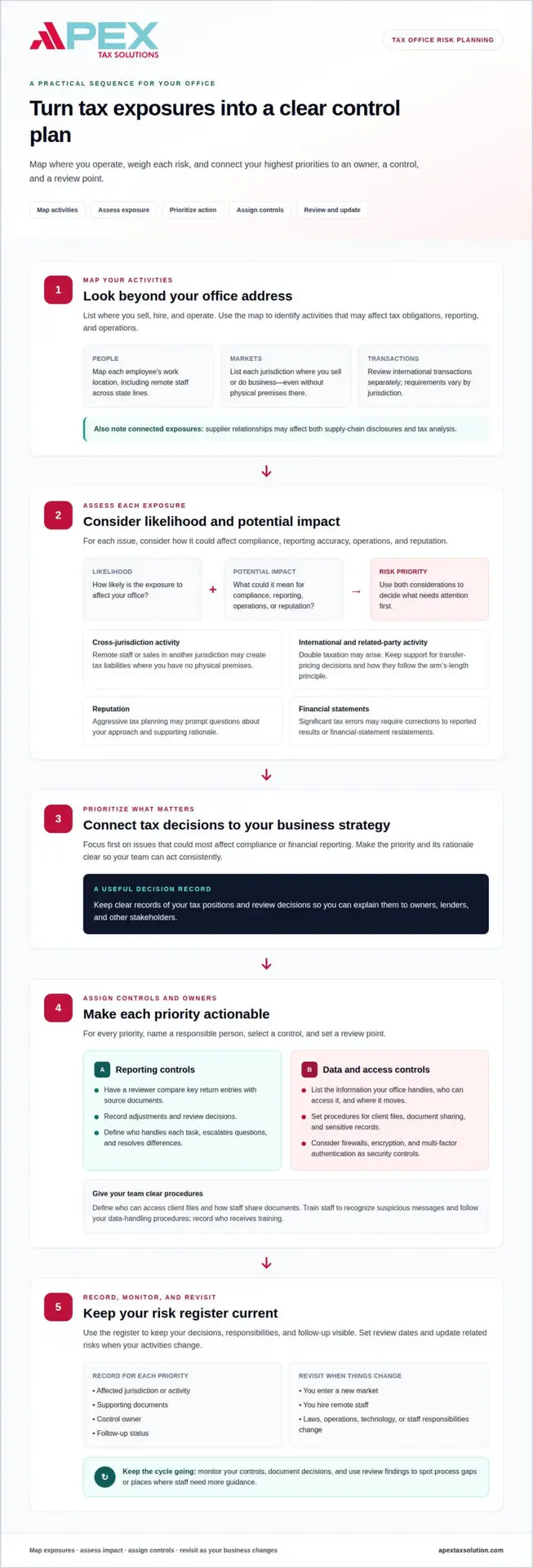
A tax risk plan should map your activities, assess each exposure, assign controls, and set review dates. Start by listing where you sell, hire, and operate, then prioritize risks by likelihood and potential impact.
Look beyond your office address. Employing remote staff across state lines or selling into other jurisdictions may create tax liabilities where you have no physical premises. Map each employee’s work location and each market where you do business. Use that map to identify tax obligations that may affect reporting and operations.
Review international transactions separately because tax requirements vary by jurisdiction, and double taxation may arise. For transactions with related parties, examine how you set and support transfer prices. Tax authorities scrutinize these transactions to assess whether pricing follows the arm’s-length principle and transfer-pricing rules. Keep documentation explaining your pricing decisions and supporting your reporting.
Consider how tax risks connect with sustainability and regulatory reporting when assessing broader business exposure. For example, a supplier relationship may affect both supply-chain disclosures and tax analysis. More transparent tax and financial reporting can give tax administrations information to investigate and use in assessments. Identify activities that raise connected financial, environmental, or regulatory concerns.
Reputational and Financial-Statement Risks
Reputational and financial-statement risks arise when tax decisions weaken stakeholder confidence or require corrections to reported results. Aggressive tax planning may prompt questions about your approach and supporting rationale. Significant tax errors may require financial-statement restatements. Keep clear records and review decisions consistently so you can explain your positions to owners, lenders, and other stakeholders.
Tax Risk Assessment and Management Planning
A tax risk assessment identifies exposures, evaluates their likelihood and potential impact, and prioritizes action. Consider how each issue could affect compliance, reporting accuracy, operations, and reputation. For each priority, name a responsible person, select a control, and set a review point. This links tax decisions to business strategy instead of leaving risk review until year-end.
Record each priority in a risk register. Include the affected jurisdiction or activity, supporting documents, control owner, and follow-up status. When you enter a new market or hire remote staff, revisit related risks and update the register. This creates a practical record of your decisions and actions to manage tax exposure.
What is Tax Risk Assessment?
A tax risk assessment identifies exposures, evaluates their likelihood and potential impact, and prioritizes controls. In your office, assess both tax reporting processes and the systems that protect taxpayer information.
Internal Controls and Employee Training
Internal controls combine clear policies, assigned responsibilities, and systems that help prevent or detect errors. Staff need consistent procedures for handling sensitive records, particularly when workloads or roles change.
Define which employees can access client files, how your team shares documents, and who reviews completed work. Train staff to recognize suspicious messages and follow your data-handling procedures. According to the Internal Revenue Service, Publication 4557 provides guidance on protecting taxpayer data. Use that publication to shape your office procedures, record who receives training, and review whether your practices still fit your workflows. Your tax office risk assessment and management plan should connect each control to the information it protects.
Tax Reporting Controls and Oversight
Reporting controls are the steps you use to prepare, check, and support tax information. They help your team catch missing documents, inconsistent figures, or unsupported entries before filing.
For example, one staff member can enter return information while another qualified reviewer compares key entries with source documents. Record adjustments and review decisions. Define who handles each task, how staff escalate questions, and how the team resolves differences. Reviewing findings over time can show where procedures need clarification or staff need additional guidance.
Tax Agency Risk Assessment Frameworks
U.S. tax agencies use risk-based processes to focus attention on higher-risk cases. The IRS Safeguards program uses a multiphase, risk-based initiative and gathers information through on-site reviews, remote assessments, out-of-cycle reviews, and agency reports, including CAPs and SSRs.
For your office’s cybersecurity work, the NIST Cybersecurity Framework can help organize security activities. It guides cybersecurity work; it is not a tax-agency examination method. Keep that distinction clear as you develop your approach. Your tax office risk assessment and management process should address your operations and help evaluate whether internal controls remain effective.
Before adding systems, assess the controls you already use. List the information your office handles, who can access it, and where it moves. Identify weaknesses, estimate potential impacts, and assign an owner to each corrective action. A firewall controls network access routes. Encryption makes data unreadable without decryption. Multi-factor authentication adds an identity-verification step.
Review password practices, access permissions, backups, and staff responsibilities together. Explain each control to the employees who use it, then have managers assess whether it works as intended. Update your assessment when changes to technology, information, staff responsibilities, or operations affect security risks.
Reviewing tax risk policies after business or regulatory changes
Consider both federal and state requirements when managing tax and data-security risks. The FTC Safeguards Rule sets requirements for covered financial institutions. Whether it applies depends on your firm’s circumstances, while state requirements depend on where and how you operate.
Review your tax risk policy when legislation or business activity changes. A new market, revised supply chain, merger, or change in staff responsibilities can affect tax processes and controls. For example, if you add remote employees, assess how their locations affect reporting processes and how you oversee their work.
Assign someone to track tax law changes and connect relevant changes to your procedures. During each review, identify affected activities, decide which processes need updating, and assign responsibility for implementation. Involve the people who manage tax work, information security, and operations so the revised policy reflects how your office works.
Use changes as specific review triggers. Record what changed, which process it affects, who owns the review, and what action you chose. For example:
- Legislation changes: Identify affected calculations or filings, then update procedures and staff references.
- A new operating model: Assess how new services, locations, or supply-chain arrangements affect your tax work and reporting.
- A merger or major transaction: Clarify tax responsibilities and records before you combine processes.
- Staff turnover or reorganization: Transfer process knowledge and assign each control to a responsible person.
- Stakeholder concerns: Review how you document your tax approach and respond to sustainability or regulatory reporting questions.
Review examination activity and findings, too. If you face more tax examinations or unexpected findings, assess whether documentation, review, or oversight needs improvement. When technology or staff duties change, revisit access permissions and information-handling procedures alongside tax controls.
Schedule regular policy reviews and add one after a significant business or regulatory change. Record the issue, its potential effect, the control changed, and who will follow up. This creates a clear record of decisions and helps you communicate updates to staff who use the affected process.
Keep your policy practical and connected to daily operations. If legislation affects a filing process, update the procedure and explain the change to the staff who handle it. If a transaction changes reporting responsibilities, assign an owner before routine work resumes. These steps help keep tax practices current as your business evolves.
How can small businesses manage tax compliance costs while minimizing risks?
Combine regular monitoring, documented reviews, and targeted improvements to catch errors before they spread.
The IRS administers federal tax obligations, state tax agencies administer state requirements, and private preparers manage their own controls while preparing client returns. Because their roles differ, map your office procedures to the jurisdictions and services you handle.
The IRS uses traditional methods and AI to identify potentially noncompliant returns. Risk indicators direct attention, but they do not, by themselves, prove a return contains an error.
For business continuity, maintain secure backups, assign staff responsibilities, and document how your office will restore access to essential records after a disruption. Test recovery steps so employees understand their roles.
Risk Monitoring and Compliance Audits
Risk monitoring tracks whether controls work, while a compliance audit reviews records and reporting for problems. Together, they can reveal recurring errors and help improve processes before the next filing cycle. For example, review rejected returns, late documents, and repeated data-entry corrections to identify where staff need clearer procedures or additional review.
Record each finding, its cause, and the corrective action. Then assess whether the change reduced the same issue in later work.
Documentation and Compliance Reviews
Tax documentation preserves support for calculations, reporting choices, and adjustments. A compliance review compares that support with filed information, helping your office explain decisions and identify gaps. For example, link an adjustment to its source documents and reviewer notes so another staff member can follow the reasoning.
Use a consistent file structure and review checklist. They make follow-up easier when staff responsibilities change or questions arise.
Compliance and Financial Penalties
Underreporting tax obligations can lead to additional tax, interest, or penalties. Missing planning opportunities can also mean paying more tax than legally owed. Reviewing return inputs and supporting documents helps address both exposures.
Prioritize reviews according to an error’s potential impact and likelihood of recurrence. For example, repeated omissions in one reporting process may warrant an added approval step.
Internal Compliance Policies
An internal compliance policy defines responsibilities, review steps, and how staff handle tax work. Clear procedures help employees apply tax laws consistently and reduce reliance on informal knowledge.
Specify who prepares, reviews, and approves work, then train staff on the policy. Revisit it when operations or tax processes change, and record updates so employees follow the current procedure.
Technology can help organize records, flag missing information, and reveal patterns across returns. Treat AI outputs as prompts for evaluation, not substitutes for professional judgment. Preparers should check flagged items against source documents, explain corrections, and retain relevant decision records.
Scope of a tax office cybersecurity risk assessment
A useful cybersecurity risk assessment follows taxpayer information through your office, from intake to storage, use, and disposal. This scope helps you make security decisions based on actual data flows, systems, and staff responsibilities.
Start by listing the information and technology your organization uses. Include taxpayer records, identity details, tax software, email, file storage, office devices, and backup systems. Map who can access each item and how information moves among employees, clients, and service providers. For example, trace a client document from receipt through preparation, review, and retention.
The NIST Cybersecurity Framework offers a structure for organizing cybersecurity work. Apply it to identify important assets, protect them, detect suspicious activity, respond to incidents, and recover operations. The Internal Revenue Service says Publication 5708 helps tax and accounting practices develop a Written Information Security Plan, or WISP. A WISP documents your firm’s security program and assigned safeguards.
Include people and processes, not just computers. Review staff access, password practices, employee training, office procedures, and vendor connections. When an employee changes roles, for example, confirm access matches their new responsibilities. A remote worker’s device, shared files, and network connection also belong in the assessment because each can affect taxpayer data.
Assess threats against each information flow and existing control. Consider unauthorized access, phishing, lost devices, accidental disclosure, and unavailable records. Firewalls control network access routes, encryption makes data unreadable without decryption, and multi-factor authentication adds an identity check beyond a password. Record which safeguards address each risk and where procedures still have gaps.
Give each risk an owner and a practical follow-up action. A simple record can include affected data, possible harm, current safeguard, responsible person, and next review point. For example, if staff exchange files by email, assess who can access the messages and whether the process protects sensitive attachments. Prioritize weaknesses that could expose taxpayer information or interrupt return preparation.
Monitoring keeps the assessment current. Revisit it when technology, staff duties, information, or operations change, and check whether corrective actions were completed. A new file-sharing tool, for instance, may change who can access client records and how the office tracks access. Record the decision, control update, and person responsible for follow-through.
Build staff understanding into the plan, since a written procedure only helps when employees can apply it. Strengthen your office’s cybersecurity practices with a clear, documented approach to risk.
Apex Tax Solutions: GHL for Tax Offices
Apex Tax Solutions LLC offers GHL for Tax Offices to help tax professionals review how office operations support consistent processes. It complements its technology and training offerings, including web-based software, corporate software solutions, and Wisp & Cybersecurity Training. Each addresses a different part of running a tax office, from software tools to cybersecurity education.
If your risk review shows staff need clearer cybersecurity practices, Wisp & Cybersecurity Training can support that learning. If you’re evaluating office tools, discuss how GHL for Tax Offices fits your workflow and goals. Contact Apex Tax Solutions LLC to talk through the next step for your tax office.
Make Your Risk Plan Part of Daily Decisions
A risk plan is useful when it shapes everyday decisions, not just annual reviews. Assign a clear owner to keep the plan active, and consider risk when deciding about new services, staffing, technology, and growth. This helps your tax office recognize when an ordinary business decision needs closer review.
Build a steady rhythm of ownership and follow-through. Schedule planned reviews, record who owns next steps, and make unresolved issues visible to the people who can address them. Your tax office risk assessment and management approach can develop with your business instead of becoming a document that no longer reflects how your team works.
If you’re ready to strengthen the systems and support behind your tax office, take the next step with a partner that understands tax professionals’ needs. Contact Apex Tax Solutions LLC today to discuss what will support your office’s goals. Keep building with confidence, one thoughtful decision at a time.
Frequently Asked Questions
How Can a Tax Office Prioritize and Document Assessment Findings?
Prioritize findings by weighing potential impact, likelihood, and how quickly a weakness could affect filings or taxpayer data. Group related issues, such as missing review steps across several return types, to address the underlying process. Record the evidence, affected workflow, accountable owner, proposed correction, and target completion date. This gives managers a clear basis for assigning resources and tracking whether each action resolves the original concern.
How Can a Tax Office Turn Assessment Results into Stronger Protection?
Turn each finding into a specific change to a control, procedure, or staff practice. If a review finds that former employees retain access to shared files, for example, add an access-removal step to the departure process and test it during the next staff transition. Explain the revised procedure to affected employees, retain evidence of the change, and check that the control works as intended before closing the finding.
How do you deal with tax risk?
Choose a response that matches the tax risk: reduce it with a control, monitor it, or change the activity creating it. For example, if a return process repeatedly lacks supporting documents, require a documented review before submission. Assign a staff owner and record the decision. For a complex tax position, organize the facts and supporting records for qualified tax advice.
How should the firm track remediation and review?
Use a remediation log linking each finding to its cause, owner, corrective action, status, and closure evidence. Record when staff implemented the change and who reviewed its operation. Keep a finding open if the control exists only on paper or fails during testing. Reopen it if later errors show the fix did not address the cause, then document the revised action and review outcome.
What common mistakes can put businesses at risk for tax compliance issues?
Common mistakes include relying on memory for filing procedures, keeping incomplete support for tax decisions, and failing to communicate process changes to everyone affected. A staff member may, for example, continue using an old worksheet after a manager updates the office procedure. Businesses also create exposure by assuming a prior-year treatment still applies or leaving review responsibilities unclear. Written procedures and retained source documents help reduce these gaps.
What is risk assessment in tax administration?
Risk assessment in tax administration is how a tax authority identifies and evaluates risks that may affect tax compliance and revenue collection. Authorities can use the results to decide where to focus reviews or other compliance activity. This differs from an internal tax office assessment, which focuses on the office’s preparation, reporting, operational, and information-security processes. Both approaches prioritize attention according to potential risk.
What are the main risks faced by a tax office?
A tax office faces risks from inaccurate return information, incomplete client records, missed workflow steps, unauthorized access, and disruptions that prevent staff from reaching essential files. Staff turnover can leave important process knowledge undocumented. For example, if only one employee knows how to complete a recurring review, the task may be delayed when that person is unavailable. Identify risks across people, processes, information, and technology.
How do tax offices identify and assess operational, compliance, and cybersecurity risks?
Tax offices identify risks by examining how work moves through the firm, from client intake to return preparation, review, filing, and records management. Ask staff where delays or corrections occur, inspect process records, and review security events and access practices. Evaluate each issue’s possible impact and likelihood. Compare existing controls with actual workflows, since a written procedure may not reflect how employees handle information day to day.